
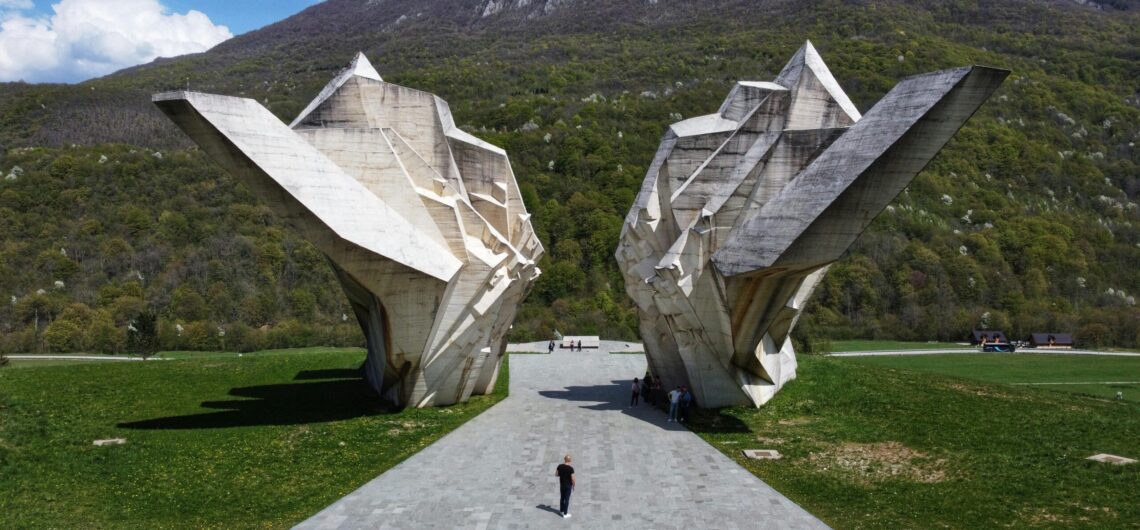
Scattered across the mountains and national parks of the former Yugoslavia — in countries such as Bosnia and Herzegovina and Croatia — are hundreds of striking brutalist monuments. These are Spomeniks: abstract brutalist monuments commissioned during Yugoslav times to honour WWII’s fallen. Some look like gigantic fists, alien spacecrafts, or wings in flight. All are extraordinary.
Spomeniks are most often found ‘in the wild’: buried in forests, rising out of national parks, and squatting on mountain peaks. This is one of rare instances where nature adventure lovers and architect enthusiasts combine: each masterpiece of brutalism can be reached on a Balkan hiking holiday or road trip.
Their striking futuristic designs have several explanations: after the war and the establishment of Yugoslavia in 1963, Tito had to forge a united country from a federation that included multiple religions and ethnicities. Architects and sculptors were briefed to create something that would not offend the different sides. Instead of war heroes, neutral abstract designs were chosen, aligning with modernist trends of the 1960s to 1980s.
Of the thousand-plus former Yugoslav spomeniks that once existed, only a few hundred remain. Some are well maintained, with museums and parks attached. Others were destroyed during the Yugoslav Wars of the 1990s; or were vandalised, forgotten, or reclaimed by nature. Some have been stripped to their concrete skeletons, like the Monument on Mount Makljen (Tito’s Fist).
A comprehensive Spomenik database was created in 2016 by Donald Niebyl which documents every monument of the region. Here, we narrow it down to the spomeniks you can experience along beautiful hiking routes or scenic drives – including several we visit on our small-group adventures in the Balkans – and how to incorporate these fascinating sculptures into an adventure into nature.
Bosnia & Herzegovina: brutalist monuments in the heart of the Balkans
Battle of Sutjeska Memorial Complex — Tjentište, Bosnia and Herzegovina
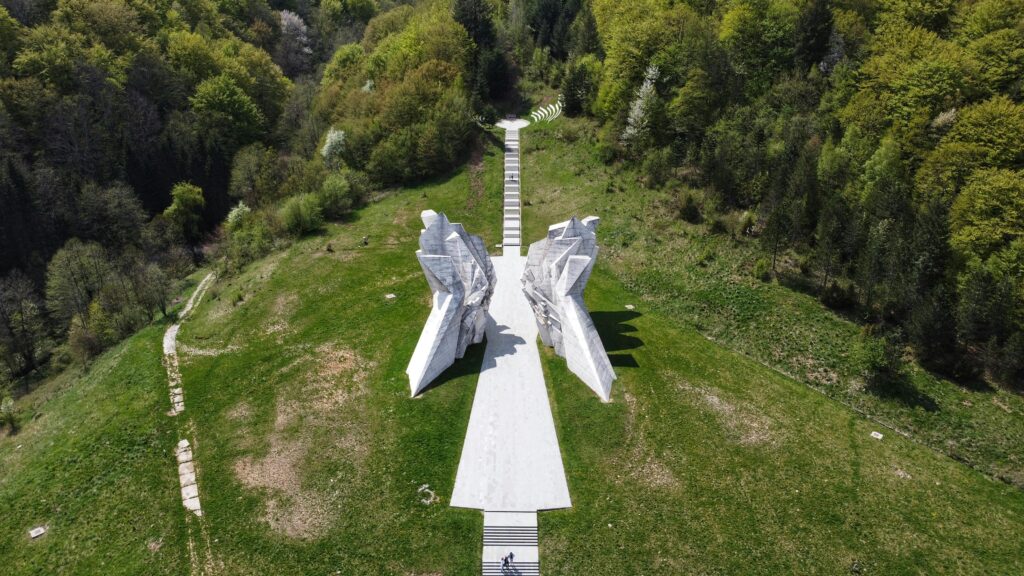
Built: 1971 by Miodrag Živković & Ranko Radović.
Access: Navigate to The Valley of the Heroes (Dolina heroja). Several trails lead to the monument, including the moderate 8.8 km Hiking Along Sutjeska trail which takes approx 2.5 hours.
Pictured in the heading, this is the crown jewel of Yugoslav brutalist architecture. Approaching it from the Sutjeska national park is a theatrical moment when you appreciate the breathtaking scale (19m high and 25m wide). The spomenik looks like two sweeping white concrete walls pulling apart from each other, or like a pair of hands framing the forest behind. It was built to honour the fallen of the Battle of Sutjeska (May–June 1943).
A nearby Spomen-Dom holds restored frescoes by Croatian artist Krsto Hegedušić and a wall with 7,000 inscribed names of battle victims. We visit on Day 3 of our Bosnia Hiking holiday.
Monument to the Revolution – Korčanica/Bosanska Krajina Partisan Hospital, Bosnia and Herzegovina
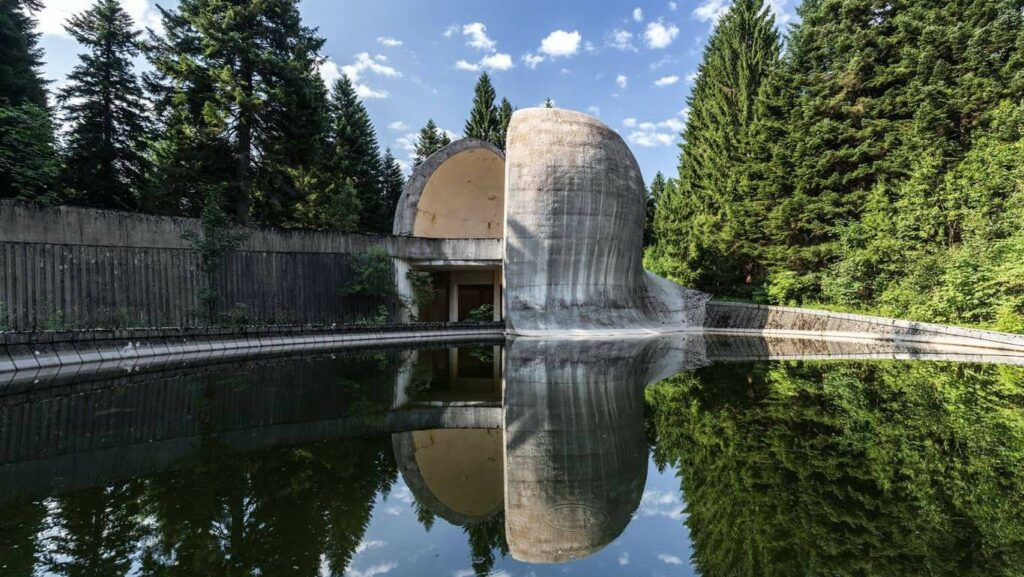
Built: 1979, Ljubomir Denković
Access: In the North-West corner of Bosnia, on the route from the Plitvice Lakes National Park in Croatia into Bosnia, direction Ključ. Drive to the abandoned Korčanica Hotel off the road between Bosanska Krupa and Sanski Most. Park there and walk approximately 300 meters into the forest along a path. The trail may be muddy.
One of the most unsettling brutalist monuments in the region. Two abstract concrete forms resembling giant telephones, listening ears, or outstretched tongues depending on the angle, sit in an eerie forest. The whole area has a haunted feel, in part due to the abandoned hotel and remote location – or perhaps because it is a burial place of fallen soldiers. This one was built to honour the Krajina partisan division who fought against the Nazis and Fascists.
Want to hike through Bosnia’s national parks to reach spomeniks? Check out our Bosnian hiking holidays.
Serbia: Yugoslav history and hiking near Belgrade
Stjepan Filipović Monument — Valjevo, Serbia
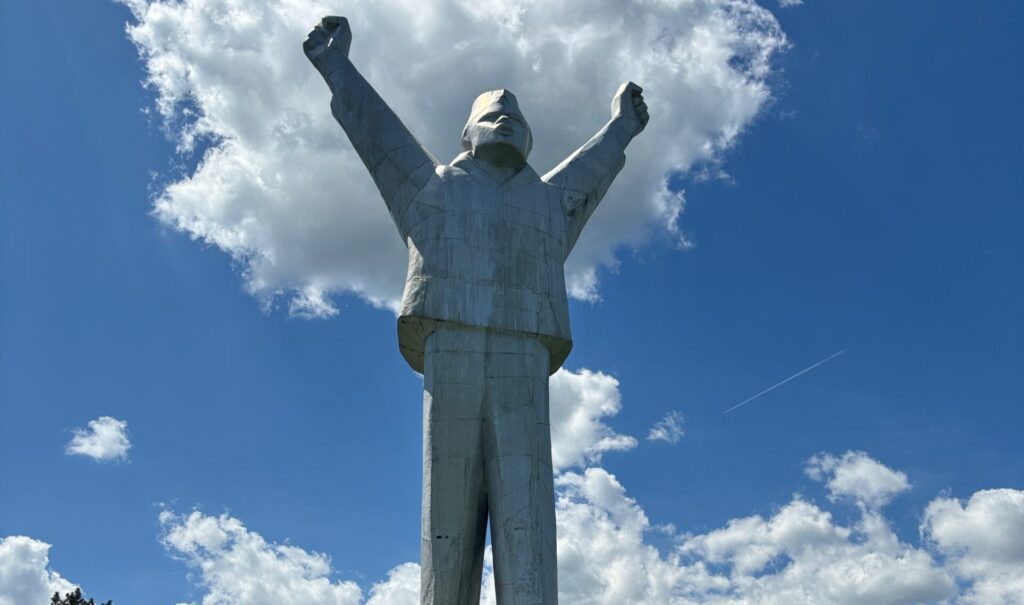
Built: 1960 by Vojin Bakić
Access: On Vidrak Hill in Valjevo, Serbia, easily accessible via a paved walking path from the town centre, roughly a 15–20 minute walk uphill. Visitors can drive to the adjacent St. George’s Church, as we do on our Serbia Activity Holiday, or walk from the town centre, offering scenic views of the city.
One of few figurative spomeniks, this bronze figure depicts Yugoslav Partisan commander Stjepan Filipović in the seconds before his execution in 1942, both arms raised above his head as he called out to the watching crowd below. The image became one of the defining icons of Tito’s WWII resistance.
Kadinjača Memorial Complex — Užice, Serbia
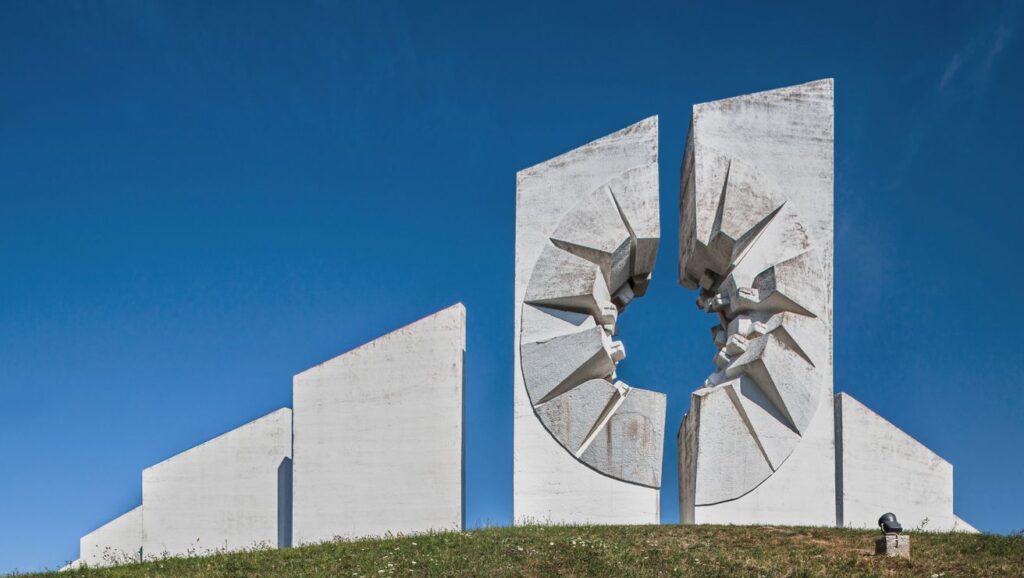
Built: 1979 by Miodrag Živković & Aleksandar Đokić
Access: This sprawling site is situated on a hill in the village of Kadinjača, a 15-20 minute drive from Užice, along the main road toward Bajina Bašta. Park up and explore the large 15-hectare complex with multiple monuments.
Set on a quiet hillside where a workers’ battalion held off a vastly larger German force in 1941, this striking piece of modernist, abstract sculpture is backed by a memorial park. A central broken-eye frames the landscape, giving the panoramas a cinematic twist.
Kadinjača is another must-see on our 7-day Serbia Adventure.
Bubanj Memorial Park (Three Fists) — Niš, Serbia
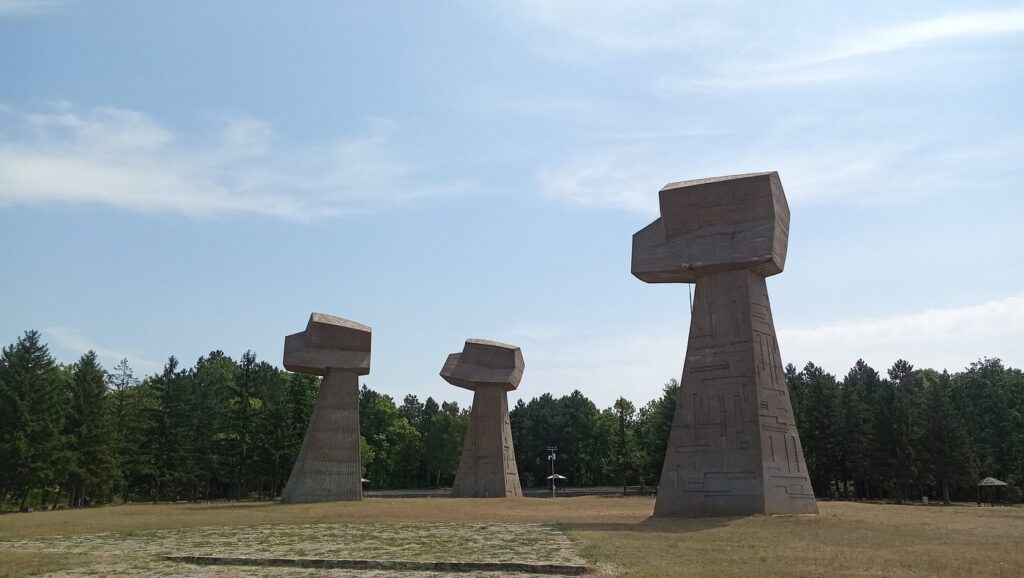
Built: 1963 by Mihajlo Mitrović & Ivan Sabolić
Access: The park is located on a hill about 3km southwest of central Niš, and is a scenic walk from the bus stop. A quick drive from downtown Niš and a carpark is available at the entrance. A wide, paved pathway leads up to the main monument.
Three enormous clenched fists rise from the ground on the outskirts of Niš, commemorating the thousands of victims of a nearby wartime concentration camp. The etchings on the stone make the spomeniks look faintly Egyptian.
We drive through Niš on the way to the Stara Planina National Park, one of the stops on our new 7-Day hiking holiday in Serbia.
Montenegro: Balkan brutalism on the coast and mountains
Monument of the Revolution — Virpazar, Montenegro
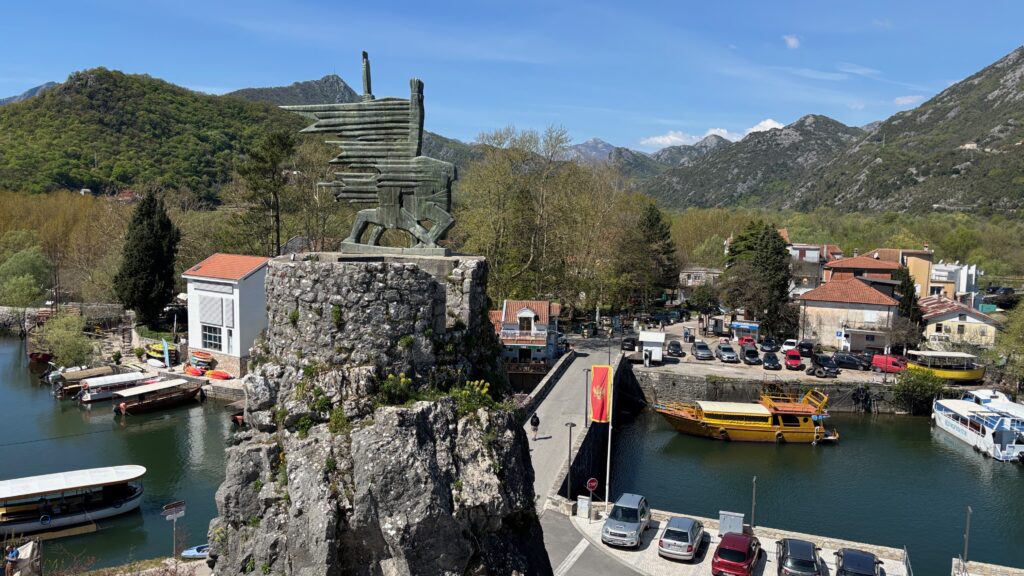
Built: 1963 by Mirko Ostoja
Access: This powerful monument is easily reached on foot from any point in Virpazar village, which is small and mostly pedestrianised.
This spomenik commemorates the Partisan fighters and veterans who fell and fought during what is locally known as the People’s Liberation Struggle (1941–1945) against fascist occupation in Montenegro and Albania. Virpazar is widely credited with being the starting point of popular armed resistance in Montenegro during WWII, on 13th July 1941. The work depicts two bronze Partisans in action, one with weapons pointed at the enemy and the other waving a flag with arms raised in victory. The mount upon which the monument sits was originally occupied by a small late 19th century chapel.
Come and see it on our Lake Skadar activity holiday. which uses nearby Villa Miela as a base.
Spomenik Strijeljanim Rodoljubima 1943 (Monument to the Shot Patriots) — Ulcinj, Montenegro
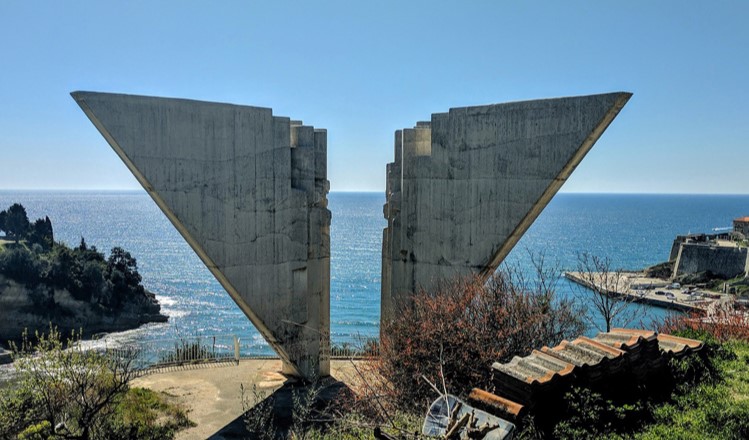
Built: 1977 by Cvetko Bošković
Access: Navigate to the village of Bijela Gora in Ulcinj, park and walk to the monument from the road.
An isolated memorial near the Albanian border, set among the saltpans of Ulcinj. The solitude of its location gives it a particular intensity, especially when the grey concrete is set against a blue sea on a clear day. You may even see flamingos on the Ulcinj saltpans too!
Croatia: Communist sculptures on the coast
Stone Flower — Jasenovac, Croatia
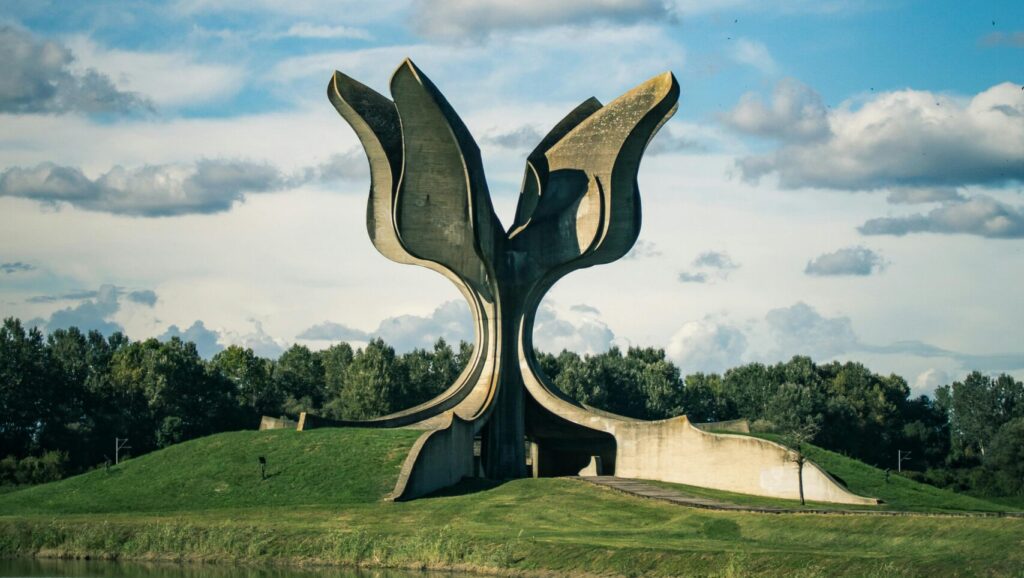
Built: 1966 by Bogdan Bogdanović
Access: Drive from Zagreb (~1.5 hours) to Jasenovac and follow directions to the memorial site and museum. After this, you can carry on driving over the border to Bosnia.
In Jasenovac, on a flat plain beside the Sava River, stands a 24m concrete work built at the site of a former concentration camp. The petals curve upward and inward, forming a shape that is organic and monumental. It is one of the most visited Spomeniks of all and a poignant memorial to hundreds of thousands killed in Jasenovac concentration camps.
Seagull Wings Monument (Galebova krila) — Podgora, Croatia
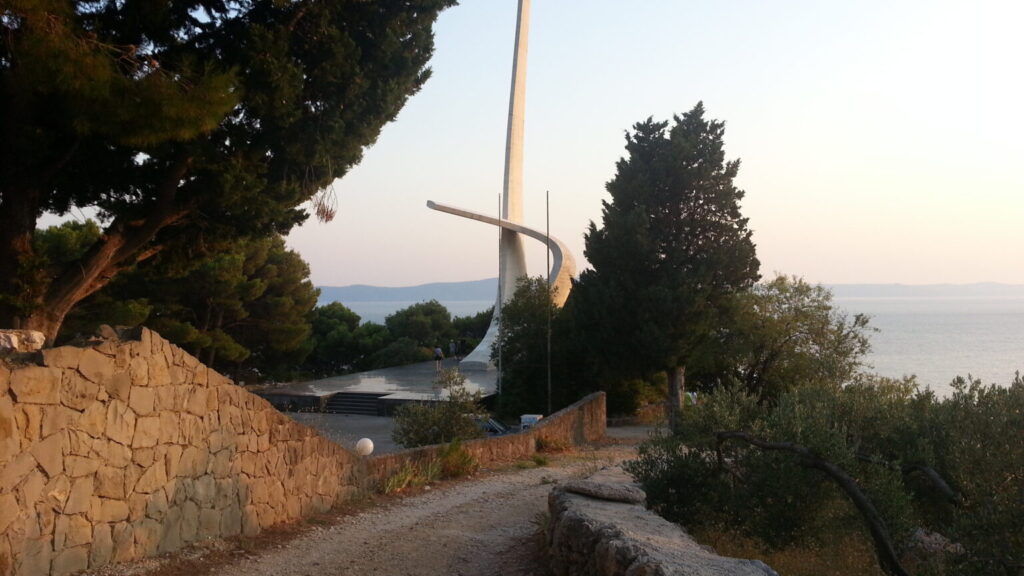
Built: 1962 by Rajko Radović
Access: Easily accessed via a steep, short walk (under 15 minutes) from Podgora’s marina. Located on a hill in upper Podgora, the memorial is accessible from the main coastal by turning up into the town. A quick drive up a narrow road above the town – turn left onto Ulica Ivana Gorana Kovačića, then take the immediate sharp left uphill, passing a football pitch. There is limited parking space near the top of the hill.
This was a naval memorial to the sailors and marines of WWII. Twin curved concrete forms rise above the Adriatic at this small Dalmatian coastal town, representing the wings of a seagull in flight. The design changes completely depending on your viewing angle, so its worth circling the base of the spomenik. Stop by if you join our Southern Dalmatia Croatia holidays.
Monument to fallen defenders, Broken Ring — Zagreb (Pleso)
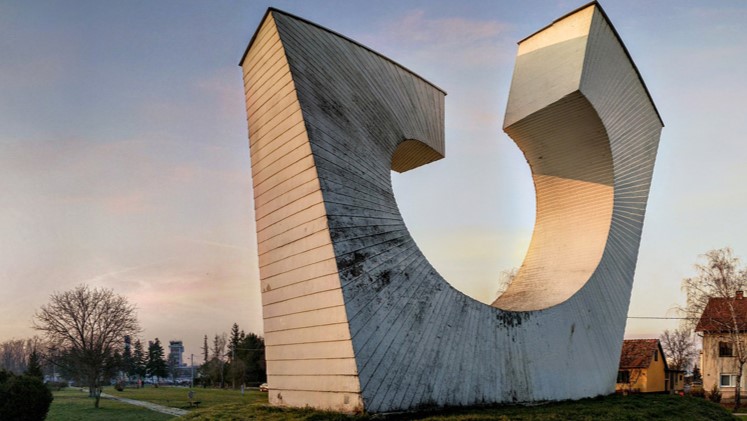
Built: 1978 by Marijan Burger
Access: By Zagreb’s airport in Pleso, the Broken Ring is an 11-metre concrete structure representing the Yugoslav Army breaking the defensive ring around Zagreb in 1945. Square in form with a deliberate offset opening at the top, it is easy to pass on the road and worth stopping for.
North Macedonia: the ‘Brutalist Capital’ of Europe
Ilinden Memorial (Makedonium) — Kruševo, North Macedonia
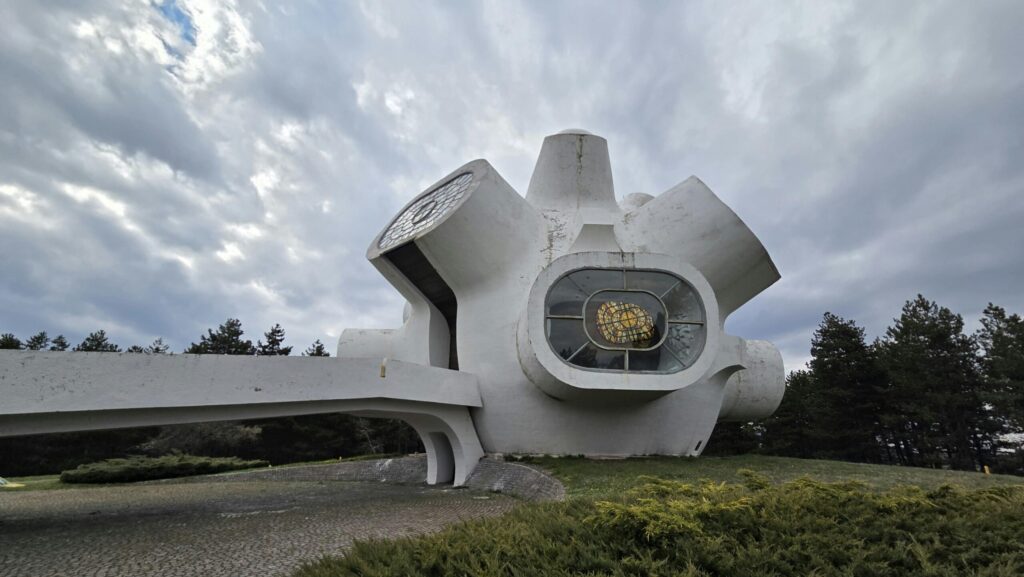
Built: 1974 by Jordan Grabulovski & Iskra Grabulovski
Access: located in the high mountain town of Kruševo, North Macedonia, specifically in the Gumenje area. It is easily accessible by car or a walking path from the town center, situated on a hill overlooking the town. Visitors can walk through a symbolic path of broken chains to reach the monument.
The standout monument in North Macedonia. A striking spherical structure dedicated both to Partisan fighters of World War II and to participants in the Ilinden Uprising of 1903 — an organised revolt against the Ottoman Empire. The dual dedication makes this one of the most historically layered of all the Yugoslav brutalist monuments.
Get around on our 7 day North Macedonia Activity Holiday.
Monument to the Revolution — Struga, North Macedonia
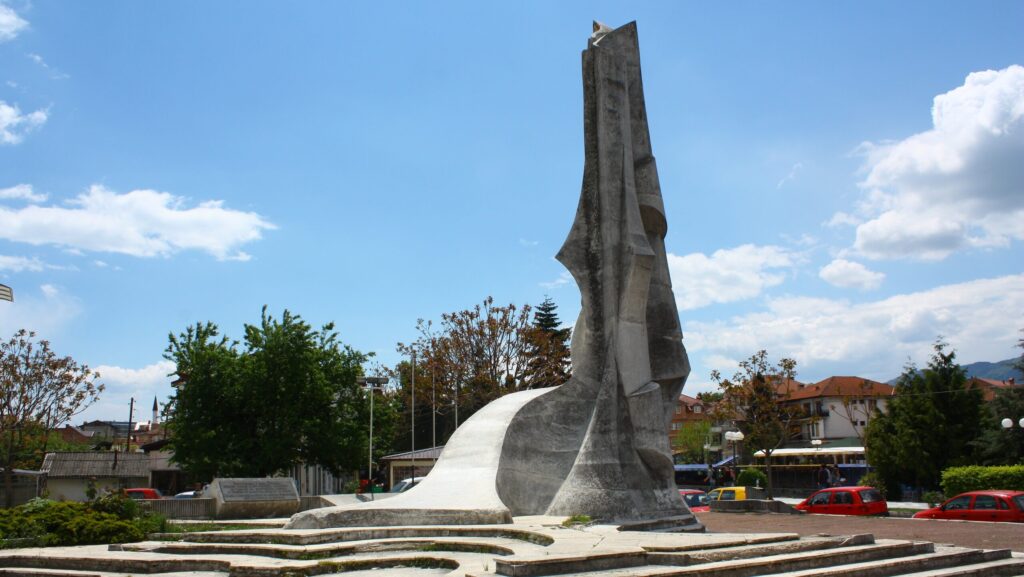
A lesser-visited monument in the lakeside town of Struga, on the shores of Lake Ohrid. We visit Ohrid on our North Macedonia Activity Holiday, which is new for 2026!
Come and see the Skopje, Europe’s brutalist capital, for yourself on our North Macedonia activity holiday.
Kosovo: the last Yugoslav partisan memorials
The Partisan Martyrs Cemetery in Velanija, Pristina, Kosovo
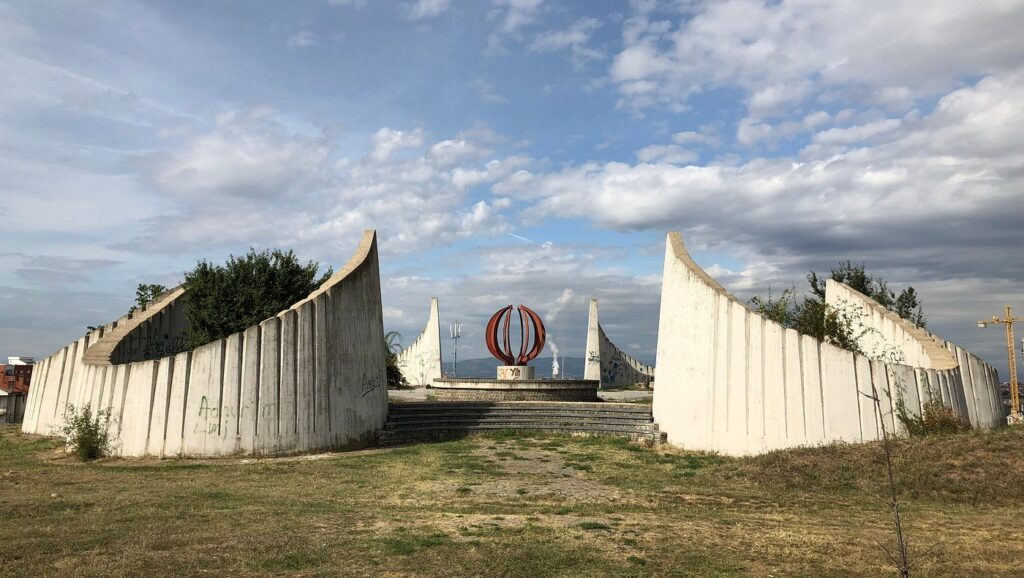
Built: 1961 by Svetislav Ličina
Access: Taxi or walk up to this hill in the Velanija district of Pristina.
The cemetery features a distinctive metal sphere on a pedestal surrounded by concrete shells, the structure is designed to represent an open flower when viewed from above, symbolizing the fallen Yugoslav partisans. The site serves as a burial place for over 200 partisans of Albanian, Serbian, and Jewish ethnicities.
Book now: Undiscovered Kosovo Activity Holiday
FAQs
How to plan a Balkans holiday around Yugoslav architecture?
What are spomeniks and why were they created?
Spomenik is the Serbo-Croatian/Slovenian word for “monument.” The term is used specifically to refer to the abstract World War II memorials built across Yugoslavia from the 1960s to the 1980s, commissioned to commemorate the battles, victims, and anti-fascist resistance of the National Liberation War.
Why do they look so unusual?
Three main reasons. First, designers were briefed to create something that would not offend any ethnic or political group in the complex post-war Yugoslav federation. Second, Tito deliberately wanted to distance Yugoslavia from Soviet-style monumental art. Third, abstract and modernist design was simply the dominant architectural fashion of the era.
How many are left?
Of the thousand-plus built, only a few hundred survive in any meaningful form. Many were destroyed or damaged during the Yugoslav Wars of the 1990s; others were vandalised, stripped for materials, or simply abandoned and reclaimed by nature.
Are they easy to visit?
It varies greatly. Some are in well-maintained parks with museums and good road access. Others require a car, a sense of adventure, solid navigation, and a willingness to walk muddy tracks through remote forest. We recommend the Spomenik Database (created by Donald Niebyl) as an indispensable resource, with detailed GPS coordinates, road condition notes, and photography for most known sites.
Can I visit them as part of an organised trip?
Absolutely. Undiscovered Balkans incorporates key spomenik-monuments into several trips, including our Bosnia Hiking Holiday, Bosnia Activity Holiday, Montenegro Activity Holiday, Lake Skadar Villa Holiday, and Serbia Activity Holiday.
Feeling inspired? Subscribe to our free monthly newsletter for more travel-inspired tips about the Balkans, first dibs on our offers and tours, and our special subscriber discount.
Comments