
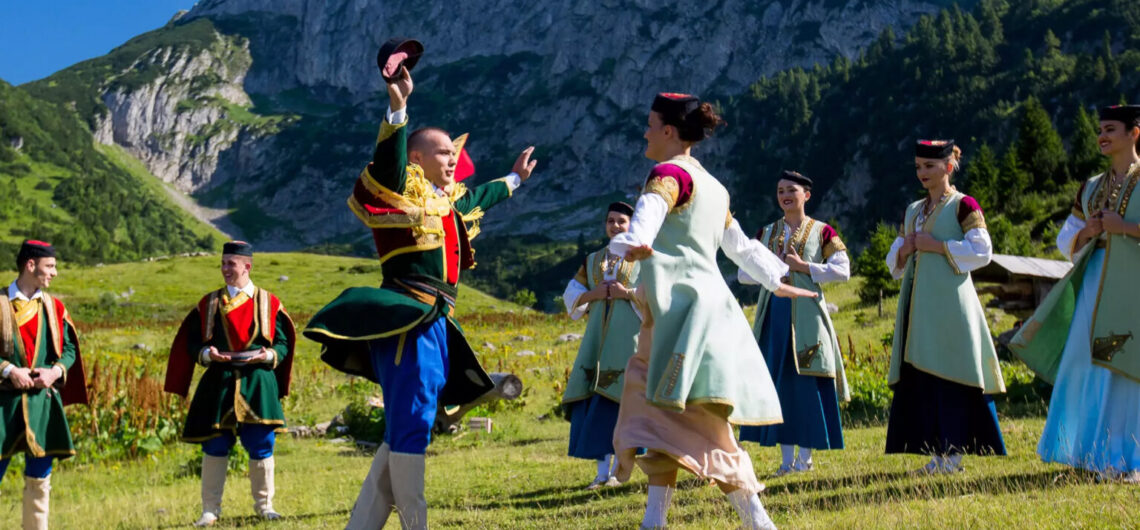
While people travel thousands of miles paying top dollar for indigenous tourism experiences, the Balkans is home to some of the richest and oldest traditions, making it the best place for authentic travel in Europe.
When we say ‘indigenous’, the word often conjures an idea of traditions practiced far away in Asia, South America, or Africa – but remember that mountain communities in the Balkans have preserved age-old traditions.
Ancient culture really is alive and well here, from the elaborate ‘Gelina’ bridal makeup in Bulgaria and Kosovo, to the delicate crafting traditions of Sarajevo’s Baščaršija. These traditions often mesh old pagan practices with Christian or Islamic rituals and local necessity. Some are recognised by UNESCO as protected intangible heritage.
In this blog, we want to answer the question: as travellers, how can we encounter these local traditions in an authentic way? We’ve been looking to solve that question on our small group holidays in the Balkans, and tailor-made trips, designed around exactly these kinds of experiences. Authentic Balkan travel is possible!
Here are 10 authentic cultural experiences in the Balkans that you don’t want to miss, from Serbia’s kafanas to Macedonia’s honey farms — all of them things we do with our guests on the ground.
And remember, the Balkans reward return visits, slow travel, and the willingness to follow an invitation wherever it leads — into a family home, a vineyard, or a festival that has been happening in the same village for five hundred years.
1. Kafana music in Serbia and other Balkan folk traditions
Accordions, trumpets, double bass and violins, soulful singing— this is the folk music you find in ‘Kafanas’, Serbia’s pub-restaurant-music taverns. The experience of going to a kafana combines eating (usually large meat platters), drinking (rakia) and singing (with as much soul as possible). It’s common to see people dancing on the tables and chairs at a kafana as the night continues!
Kafana musicians blend several genres of folk music, usually:
Starogradska muzika (old city music) which are elegant, melancholic songs from Belgrade and Novi Sad, often about lost love, longing, and heartbreak.
Narodna muzika are traditional folk songs rooted in rural Serbian villages.
Sevdalinka are soulful, Balkan blues-like melodies borrowed from Bosnian tradition with Turkish/Ottoman inflections.
Etiquette: If you’d like to request a song, you must tip the musicians, anything from 10 euros is considered appropriate. Don’t feel pressure to spend too much, the culture of tipping musicians is a way of showing off and showing status in Serbia.
Across the Balkans, you will also find hauntingly beautiful folk music and vibrant dancing.
In Albania, Iso-polyphonic singing is a mesmerising, acapella folk singing found in the Albanian mountains, The Lëpushë summer festival is a great place to watch this. Find out more here.
Here’s Undiscovered Balkans’ co-founder Emma on listening to iso-polyphonic music : “I’ll never forget sitting with a family at Divjakë-Karavasta, when the mother began to sing and the whole family joined in—at first discordant, then mesmerisingly beautiful.”
A similar style can be seen in Croatia’s Dalmatia region, a homophonic, a cappella style of singing known as Klapa. Hear it on our 7 Day Multi-Activity Holiday in Southern Dalmatia.
“Klapa singing is a big part of Croatian culture”, said Emma. “In our early days on Vis Island, our second home for years, a group of men stopped beneath our lit window and serenaded us with klapa. It’s such a soulful a cappella sound.”
In Sarajevo, we visit a venue that plays Sevdalinka: the traditional Bosnian folk songs, performed a cappella with traditional instruments. It is melancholic, soulful, and deeply specific to this part of the world. Parents often sing these songs to their children or at religious gatherings.
Last of all, we recommend you stand at a distance to listen to the gaida, or bagpipe — Bulgaria’s national instrument! You’ll also find bagpipes across Albania and Montenegro, basically, wherever there are mountains!
2. Kilim weaving in Albania: a living Ottoman craft tradition
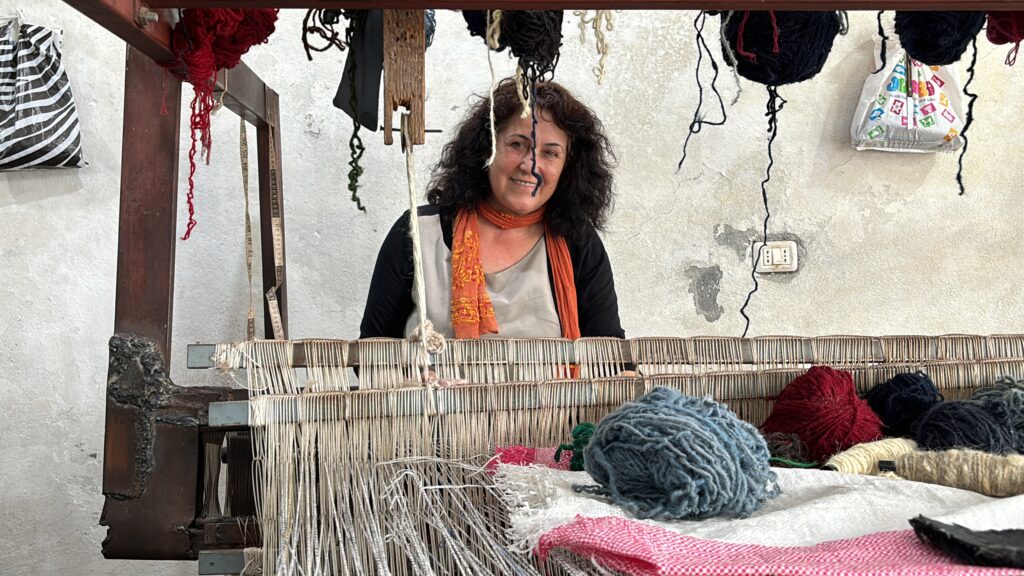
Handwoven kilims date back centuries to Ottoman times, when rugs were gifted as dowries (paja), and the motifs woven into each piece told the story of a specific place, family and tribe.
Distinct traditions are found in Albania’s Lake Shkodra region and Serbia’s Pirot near the Stara Planina, but kilims can also be found across the region, in Bosnia, Bulgaria, Macedonia and Montenegro.
Our Multi-activity holiday in Albania includes a visit to the kilim factory on the shores of Lake Shkodra where you meet the weavers and see the rugs. Heading up the women-led weaving cooperative is Nebija Qotaj. She quietly keeps the ancient craft of rug weaving alive. Nebija first sat behind a loom at just ten years old, taught by her mother and grandmother. Today, she and her colleagues produce handloom kilims and linens in warm ochres, rusts and earthy reds.
Pirot, in southern Serbia, is also highly renowned for its beautiful kilims, woven from wool of the sheep raised on the nearby Stara Planina mountains. We visit on our Serbia hiking holiday.
3. Beekeeping traditions in North Macedonia: a wild honey experience
It’s true that people in the Balkans are honey snobs. They have the best honey in Europe, maybe even the world, and beekeepers keep things as pure and natural as possible. Those who put sugar in the mix are frowned upon…
North Macedonia’s mountain meadows produce some of the finest honey in the Balkans, and the beekeeping traditions here are centuries old. A morning with a local beekeeper — suited up, smoker in hand, watching a hive being opened and worked with calm — is a lesson in patience and temptation. It’s hard to resist sticking your fingers into the comb and start eating the honey Pooh-bear style!
Join our North Macedonia itinerary for a taste of bee-keeping in a traditional village.
4. ‘Sofra’ dining in Albania and Kosovo
In northern Albania, families still observe the ancient law of the Albanian highlands, the Kanun of Leke Dukagjini, which states: “The house of the Albanian belongs to the guest.”
If you join us for dinner in the mountain village of Theth, in the heart of the Albanian Alps, you may get to experience this amazing hospitality around a low ceremonial circular table called a sofra.
The whole family gathers around, and the sofra is laden with whatever the household has made that day: cornbread, sheep’s cheese, slow-cooked lamb, pickled vegetables, and yoghurt thick enough to stand a spoon in.
When the weather closes in — and in the Albanian Alps it can close in fast — an evening around a sofra with a local family is one of the warmest and most authentic travel experiences in the Balkans. Conversation flows, raki appears, and the family’s hospitality is totally unperformed.
This fabulous cultural experience is part of our North Albania Activity Holiday, Family Peaks of the Balkans Hike, Cross-Border Hiking Holiday, and soon on our revamped Albania Food and Culture Holiday!
Combine this experience with a visit to a Malesorë shepherd hut. Every summer, shepherd families in northern Albania move their flocks to the high mountain pastures, setting up seasonal settlements called stans.
Spending a day with a shepherd family at their stan is a true immersion in a lifestyle that follows the natural rhythm of the seasons. Life here is elemental: cheese made fresh each morning, bread baked over an open fire, animals moved between grazing grounds on foot.
We also visit shepherd’s ‘katun’ villages in Montenegro on our Super-Active Montenegro Holiday, and Montenegro Hiking Holiday.
It is one of the things guests talk about most when they come home.
5. Peka cooking under the bell lid (Croatia, Serbia, Bosnia)
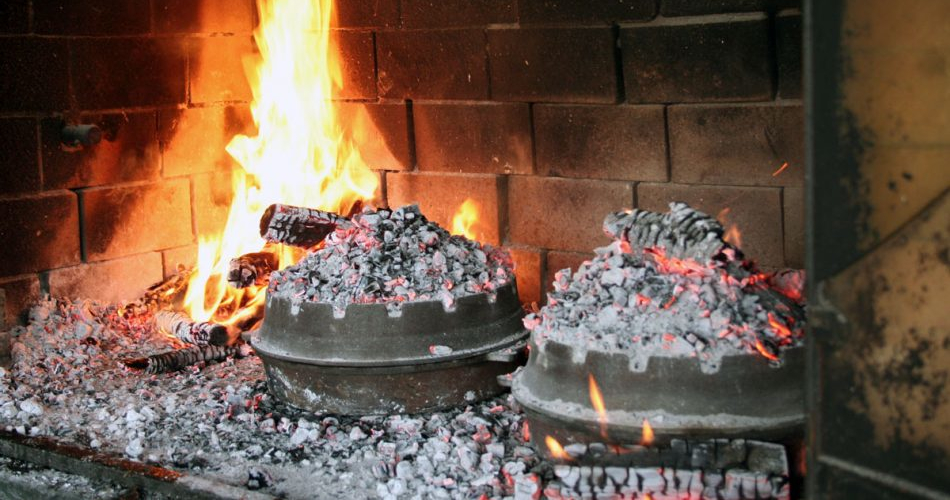
In rural Croatia, a peka is a domed iron or clay lid placed over food and buried in hot embers, slow-cooking meat, bread, and vegetables over several hours into delicious soft stews or roasts. This is one of the oldest cooking methods in the Balkans, and t’s known as ‘sač in Serbia, Montenegro and parts of Bosnia. You’ll love how the woodsmoke perfumes everything with a smoky depth.
A family homestay in Croatia or Serbia built around a sač meal is as much about the rhythm of the preparation as the food itself: watching the fire, laying the table, sitting together, eating slowly.
Get in touch to create a tailor-made Croatia holiday to spend time cooking with a family using peka pots. This is the ultimate slow food travel experience. A family homestay is also part of our Serbia hiking holiday, where you can see the sač in action.
Related: Undiscovered Tastes– the perfect “peka/sač” recipe
6. Copper Craftsmanship in Sarajevo (Bosnia & Herzegovina)
Bosnia’s craft traditions run deep, shaped by centuries of a strong culture of making things by hand, and Sarajevo has always been famous for its delicate copperwork that was coveted across the Ottoman and Austro-Hungarian empires.
To this day, whole streets are alive with the pleasing ting of hammer on metal. These artisans are making džezva copper pots (pronounced jez-vah) and coffee sets for the Bosnian morning ritual of drinking Turkish-style coffee.
Related: How to drink Bosnian coffee the right way
A copper workshop here is not a tourist activity: it is an introduction to a craft that local families have practised across generations. You’ll come away with coffee pots and grinders, tea sets, carving boards, side tables and more.
Spend time in the copper workshops on our Bosnia trips.
7. Traditional Bridal makeup in Kosovo: an ancient wedding ritual
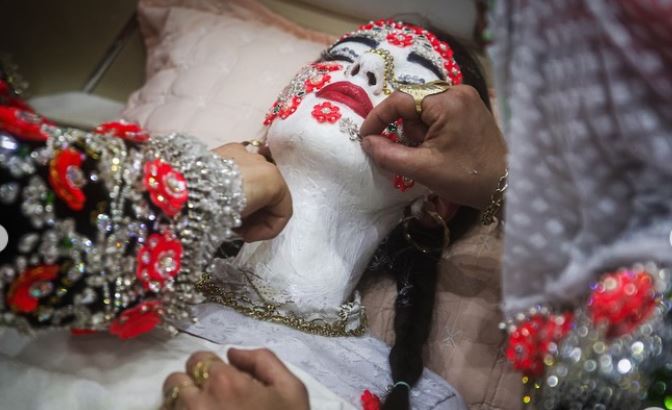
In old Kosovo Muslim communities, brides faces are painted porcelain-white — a practice rooted in symbolising purity, modesty, and virginity. The makeup is applied heavily, almost like a mask, setting the bride apart as sacred on her wedding day.
Over this white canvas, colorful gems, sequins, and metallic embellishments are carefully pressed onto the skin to catch light and giving the bride an ethereal appearance. This tradition is closely tied to the idea that the bride temporarily exists between two worlds, leaving her family home and entering her husband’s.The overall look is deliberately theatrical and symbolic to mark the wedding day as transformative.
At the end of the day, her husband must take the gems off slowly, one by one, in a ritual that shows the couple will have patience with each other.
This tradition has largely faded in urban Kosovo but can still be glimpsed in rural wedding ceremonies, kept alive by older generations honouring ancestral custom.
If you love the elaborate appearance of Kosovo’s weddings, then you’ll be interested to know that Kosovo’s tradition of silver filigree jewellery making is one of the most intricate and underappreciated crafts in the Balkans.
Thin threads of silver are twisted, bent, and soldered into extraordinarily delicate patterns — flowers, geometric forms, traditional motifs — in a process that requires patience, steady hands, and years of practice. The pieces you see in Kosovo’s markets and craft shops look simple until you understand how they are made!
On our activity holiday in Kosovo we take part in a silver filigree jewellery workshop. Attempting even the simplest element of the craft gives you a lasting respect for what these artisans produce – plus you get to take some lovely jewellery home!
8. Kolo and circle dancing traditions in Montenegro, Serbia and beyond
The Kolo circle dance of the Balkans (or ‘Valle’ in Albania) involves dancers holding hands and moving in a circular line, performed to traditional music.
Our founders have often watched it performed in December, at the Virpazar Wine and Bleak Festival that’s local to their home in Montenegro. But if you also come to Virpazar in September, you’ll see the winemakers around Lake Skadar harvesting the vines and fermenting the grapes with a traditional wooden padel. Everyone feasts and dances the Kolo afterwards.
This experience features on our Lake Skadar Activity Holiday in September and Super-Active Montenegro Holiday.
9. Nestinarstvo Fire Dancing in Bulgaria: an Ancient Pagan Ritual
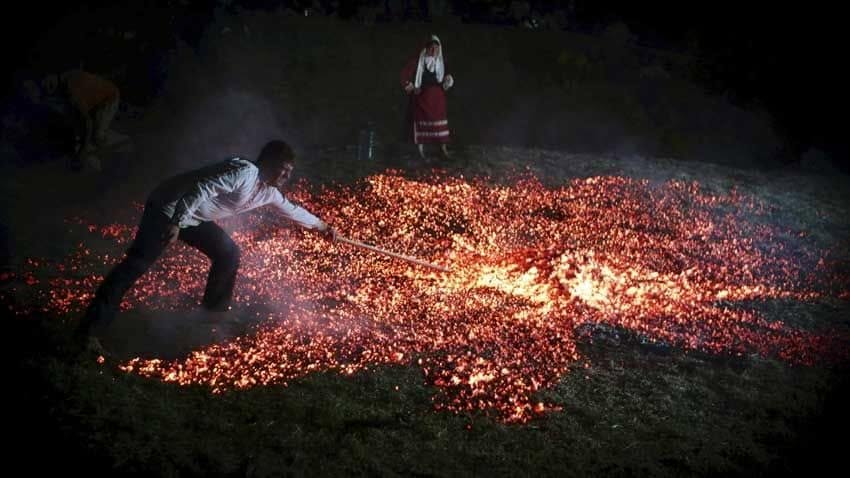
The Bulgarian tradition of Nestinarstvo (fire dancing) is a pagan ritual from the Strandzha mountain in southeast Bulgaria. Each year on 3rd June, dancers walk across hot fire embers and enter a trance in prayer to the Sun God, who they ask to deliver health, prosperity and fertility in the new year. Many tourism establishments have commercialised the dance now, so it’s common to see, but few perform it truly authentically like in the villages of Strandzha.
10. Rakija: Balkan Culture in a Cup
Here’s one that really crosses every border. Every family in the Balkans makes their own rakija (also called ‘raki’). Every family believes theirs is the best. They are all, in their own way, correct.
During Autumn harvest time, all kinds of fruit are gathered and fermented in a copper still, usually in a shed in the garden. Plum, quince, apricot, pear and walnut all go in the pot. The result varies wildly — from smooth and fragrant plum brandy to something that genuinely rearranges your afternoon plans — but the experience is always fun!
Watch out for rakija. It is delicious. It is also approximately the strength of rocket fuel. Balkan spirits contain around 53% alcohol, and being visibly drunk is considered a sign of bad character.
A word of advice that applies from Dubrovnik to Tirana: pace yourself, look your host in the eye when you say živjeli (cheers) and stop before the third round. Nobody wins the rakija game.
FAQS: What culture can you see in the Balkans?
Give us a a call! We do tailor-made holidays as well as out usual routes, and our on-the-ground expertise will get you where you wish to go.
FOLK MUSIC & SINGING
What is a kafana?
A traditional Balkan tavern with music, simple food, drink and dancing. In Serbia, folk music performed in kafana taverns – this is deeply embedded in Serbian social culture.
What is Albanian Polyphonic singing?
A mesmerising choral acapella formation recognised as UNESCO intangible heritage. Best experienced at the Lëpushë summer festival.
What is Chalga music in Bulgaria?
Dancey Bulgarian folk music popularised by Azis, of Roma origin.
What is Bosnian Sevdalinka music?
Traditional folk songs of love and longing, performed a cappella or with traditional instruments.
What is Croatian Klapa singing?
Homophonic, acappella singing from Dalmatia. UNESCO listed.
What is the Kolo Dance?
Dancers hold hands and move in a circle or long line. Danced at weddings, festivals or in the streets!
FOOD & DRINK RITUALS
What is a sofra table?
Low ceremonial table used for family hosting and eating meals together.
What is Ajvar?
A seasonal preserve made from roasted or grilled peppers. Making it is a late summer/autumn ritual in most households.
How do you make Rakia?
Every Balkan family has their own recipe. Around 53% alcohol. Homemade is the only version worth having. Made in Autumn with the glut of plums, quince, pear, apricot or whatever is available.
Bosnian Coffee Ritual
Turkish-style coffee prepared in cezve copper pots. A morning ritual and an expression of hospitality. Sets the tone for everything that follows.
What is sač or peka cooking?
Traditional slow-cooking method under a bell-shaped lid covered in embers. Used widely across the Balkans for meat and stew dishes.
What is typical Balkan breakfast?
A cultural experience in itself — burek, yoghurt, strong turkish coffee and maybe cheese, eggs, fresh bread, olives and honey.
Do the Balkans celebrate the wine harvest?
Balkan version of the vendemmia — vineyard blessings, family gatherings, seasonal celebration.
Why is Balkans honey so good?
Traditional beekeeping is important across the Balkans, particularly in mountain regions.
CRAFTS & MAKING
Kilim Weaving — Albania Handwoven rugs dating back to Ottoman times, gifted as dowries (paja). Lake Shkodra region.
Kilim Weaving — Serbia Pirot kilims, woven from wool of Stara Planina sheep.
Croatian Lacemaking Three UNESCO-recognised types: Pag needle-point lace, Lepoglava bobbin lace, Aloe lace from Hvar.
Handloom Weaving Broader tradition across Albania and Serbia. Motifs tell the story of a specific family, place and tribe.
The Peja (Kosovo / broader Balkans) A chest of heirlooms a woman takes to her marital home. Family tradition of collecting and passing down objects across generations.
Bridal Makeup Traditions Bulgaria and Kosovo — the Gelina bridal tradition in Ribnovo. Elaborate and ceremonial.
Zhubleta Skirt — Albania / North Macedonia / Kosovo / Montenegro Bell-shaped highland skirt made from wool. Around 4,000 years old. UNESCO intangible heritage. Found across the northern Balkans.
Feeling inspired? Subscribe to our free monthly newsletter for more travel-inspired tips about the Balkans, first dibs on our offers and tours, and our special subscriber discount.
Comments