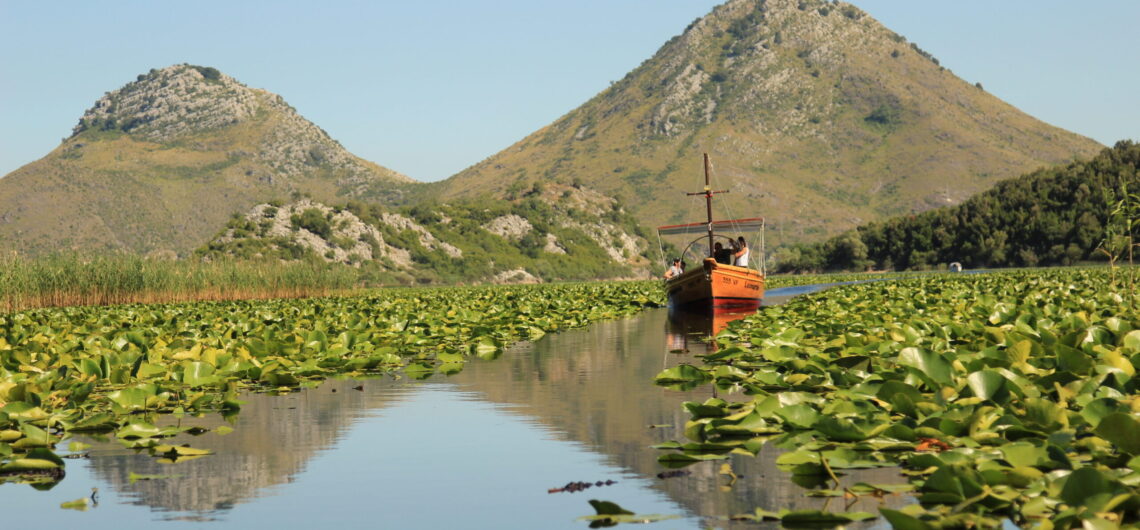
If you’ve been researching a trip to the largest lake in the Balkans, you’ve probably noticed something confusing. Some maps call it Skadar Lake. Others say Lake Shkodra or Lake Shkodër. Some sources put it in Montenegro. Others in Albania. UNESCO appears to use different names for what might be the same place. And now it’s a World Biosphere Reserve — or is it two?
Here is the short answer: Lake Skadar and Lake Shkodra are one lake, shared by two countries – Albania and Montenegro. It has just become one of the most officially protected wetland ecosystems in Europe in recognition of its exceptional biodiversity (you’ll see a lot of waterbirds, even pelicans).
We’ve been running trips here for 16 years, and this spectacular wetland is central to several of our holidays: our Lake Skadar Activity Holiday (Montenegro), our North Albania Activity Week (Albania), our Cross-Border Lake Kayaking Holiday (Montenegro to Albania) and our specialist retreats for art, yoga, paddlesports or birdwatching.
Here’s everything you need to know — and a case for why this lake deserves to be on your radar.
Is it Lake Skadar or Lake Shkodra?
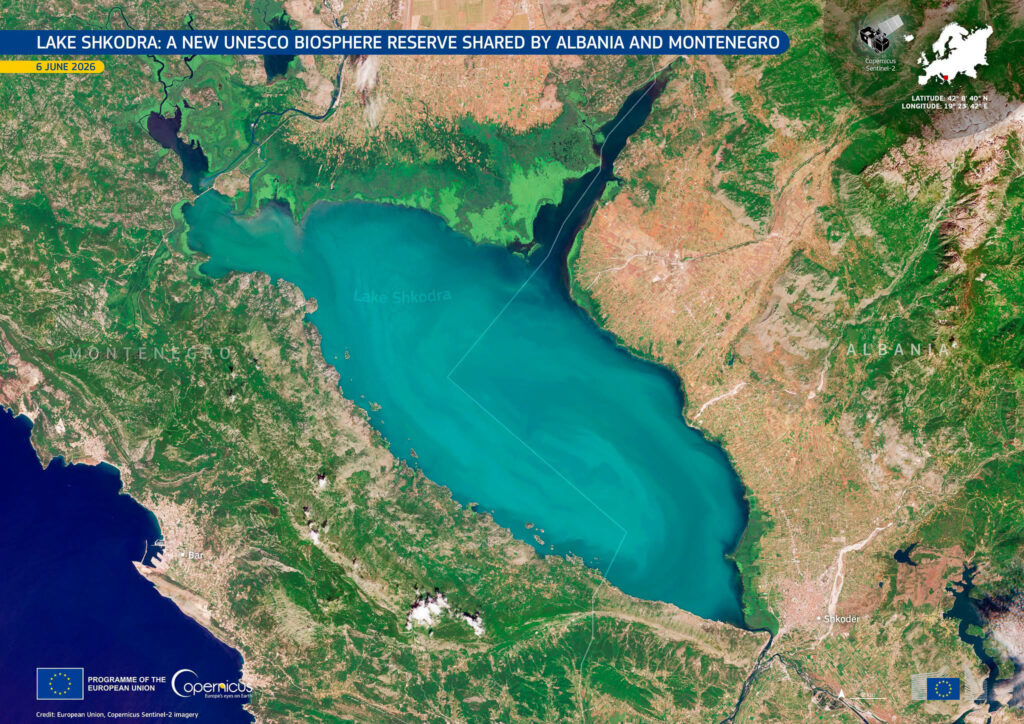
It’s both. The confusion comes from the fact that it sits across an international border, with roughly two thirds of its waters in Montenegro and one third in Albania. Each country uses its own name: Skadarsko Jezero in Montenegro, Liqeni i Shkodrës in Albania.
The lake of many names
The Illyrians called this lake ‘Labeatis’. The Romans knew it as ‘Scodra’, which was slavicised to ‘Skadar’ after the arrival of Slavic tribes in the 6th and 7th centuries. The Ottomans (Turks) called it İşkodra and ruled the entire area for a time. Modern Albanians say Shkodër (or Shkodrës). Older English language texts sometimes use Lake Scutari, borrowed from the Italian, and the Germans still say Scutarisee.
None of the lake’s many names are wrong. They are simply layers of history sitting on top of one another, which is, in many ways, a good description of the Balkans generally.
The most-used name you’ll see internationally is the English ‘Lake Skadar’, reflecting the fact that the majority of the lake lies within Montenegro — and that’s the side foreign visitors have historically explored more. Most of the time, that’s what you’ll see on maps and in travel writing — but we use Lake Shkodra or Shkodër Lake whenever we’re talking about the Albanian side of the lake. It’s the name used locally, it’s a mark of respect, and as tourism in Albania continues to grow, using the local name helps avoid confusion.
Is Lake Skadar/Shkodra a UNESCO site or a National Park?
It’s both. The lake became a UNESCO Biosphere Reserve in June 2026 on both its Montenegrin and Albanian sides — a different recognition from UNESCO’s World Heritage List and one that puts it on the global stage as one of Europe’s most important wetland ecosystems.
In Montenegro, the lake is managed by Lake Skadar National Park as UNESCO’s Skadar Lake Watershed Biosphere Reserve. In Albania, it is known as the Lake Shkodra Biosphere Reserve.
Together, UNESCO’s designations recognise what has always been ecologically true — that this is one interconnected biosphere and that protecting it requires equal commitment from both countries, together with the people who live there.
For visitors, the designation changes very little day to day. But it matters enormously for the lake’s long-term future: placing it among the world’s most valuable nature sites and providing a framework for conservation that crosses the border.
For us, this outcome is personally meaningful: we were vocal opponents of a proposed mega-resort development on the Montenegrin shore, and seeing the lake’s protection formalised at the highest international level is a win for nature!
Why Lake Skadar/Shkodra is unlike any other lake in Europe
Lake Shkodra/Skadar is a karst lake with a hydrology that has no real equivalent on the continent. Freshwater springs rise directly from the lake bed, some from a crypto-depression estimated to be 97 metres below sea level. The lake’s entire water body refreshes four times a year, producing a level of purity that is extraordinary: above the spring areas, the water is clean enough to drink. The result is an ecosystem of unusual richness. It is also vast, swelling to roughly 530 square kilometres with winter rain and snow melt.
Fun fact: the lake’s main outlet — the Bojana/Buna river — occasionally reverses direction after heavy rainfall, when the river runs so high it backs up into the lake rather than draining out to sea: a rare hydrological phenomenon that adds to the lake’s value as a habitat for aquatic species.
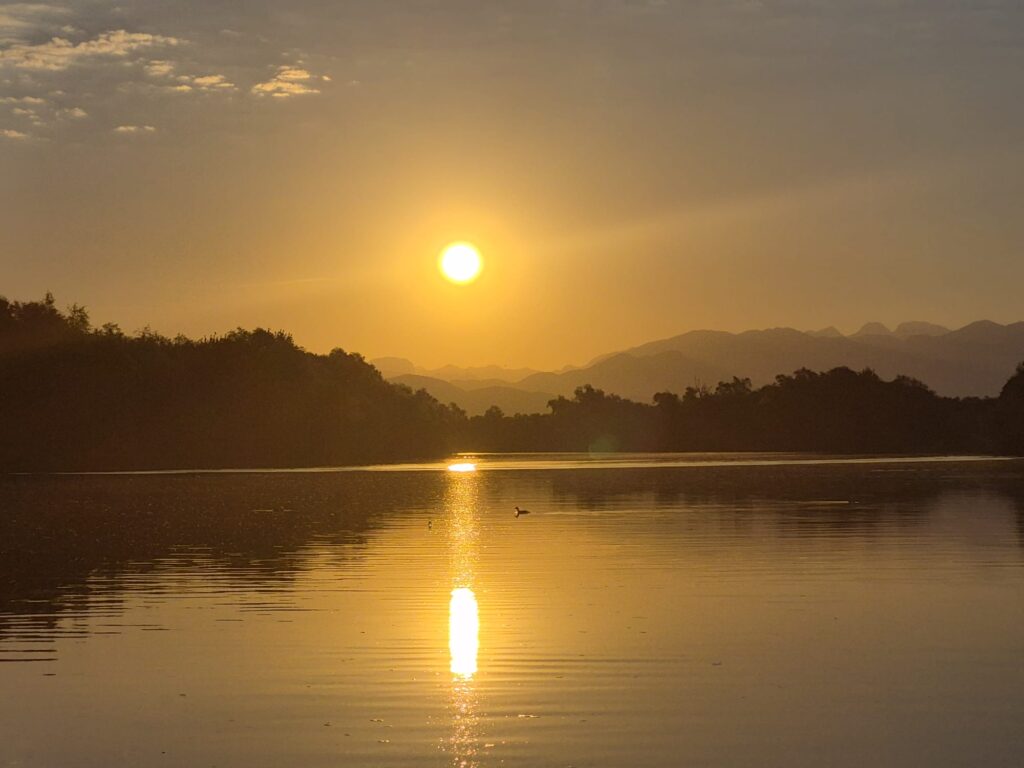
Here’s what wildlife and nature you can see on Lake Skadar/Shkodra:
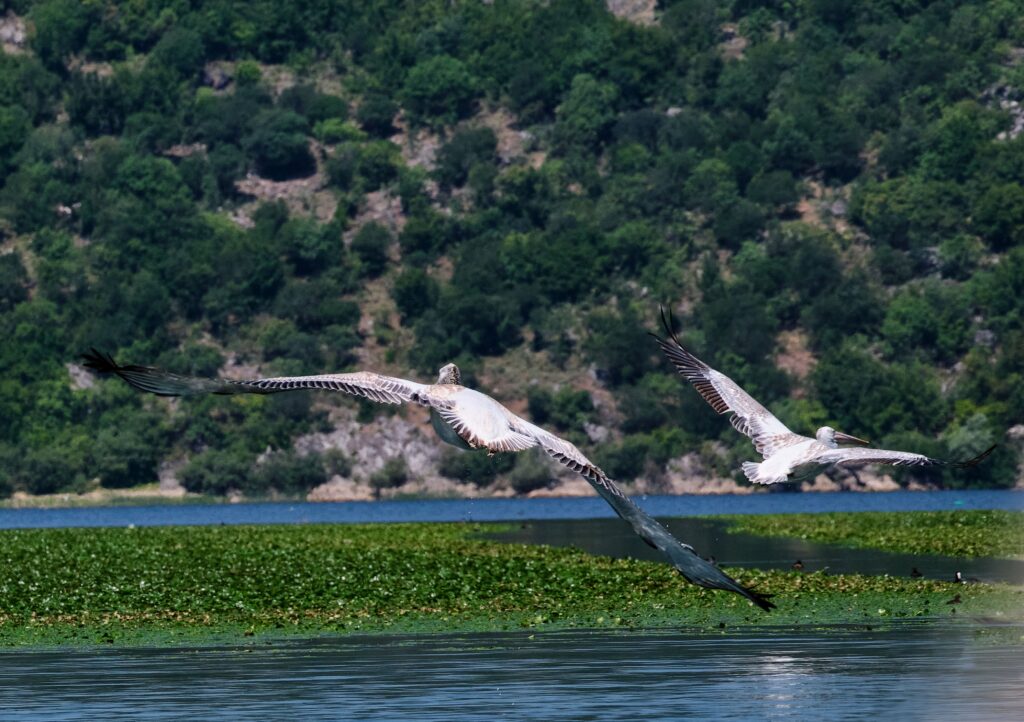
The lake holds an extraordinary number of yellow and white water lilies, flowering May to October and resembling floating meadows. It’s also one of a handful of places where the rare Dalmatian Pelican breeds; the colony here went from the brink of extinction to around 300 birds thanks to conservation efforts. Adult birds have giant wingspans of three metres.
Over 280 other bird species have been recorded here – pygmy cormorants, whiskered terns nesting on lily pads, little and great crested grebes, short-toed eagles, and rock nuthatches, alongside otters and Hermann’s tortoises.
The surrounding karst landscape, with limestone islets rising from still water and monasteries perched on rocky outcrops, draws comparisons to the ethereal lake landscapes of China and Vietnam.
“The experience of floating gently through the reeds on a calm, sunny day while reed warblers sing from within is deeply rewarding,” says our co-founder Emma, “and then a group of Dalmatian pelicans appears in the distance and glides effortlessly out over the water — it is very much their world, but the kayaks allow us to enter it in a way that feels respectful and completely extraordinary.”
Related:
- Protecting the Dalmatian Pelicans of Lake Skadar National Park
- The Undiscovered Guide to Shkodër, Albania
- Wildlife in Montenegro and Albania: where to find Brown Bears, Wolves, Pelicans and more
Things to do on Montenegro’s side of Lake Skadar
The Montenegrin shores are where most visitors begin. The main access points are Virpazar, Vranjina, and Rijeka Crnojevića, each with a distinct character.
Virpazar, where we’ve been bringing guests for 16 years, sits at the confluence of rivers in the heart of the national park. Its name gives it away: “Vir” means confluence, “Pazar” is the Turkish word for market. It is beguiling and unhurried, the starting point for many of our kayaking and hiking trips. Boat trips are the mainstay of tourism and easily arranged.
The history here runs deep. Lake Skadar is the heartland of old Montenegro, where the royal family spent summers at Rijeka Crnojevića, prior to WW1. And where, in the Krajina region near Ostros, lie the 11th century monastery ruins of Jovan Vladimir and Kosara, fabled ruler of the first southern slavic state and his beloved wife.
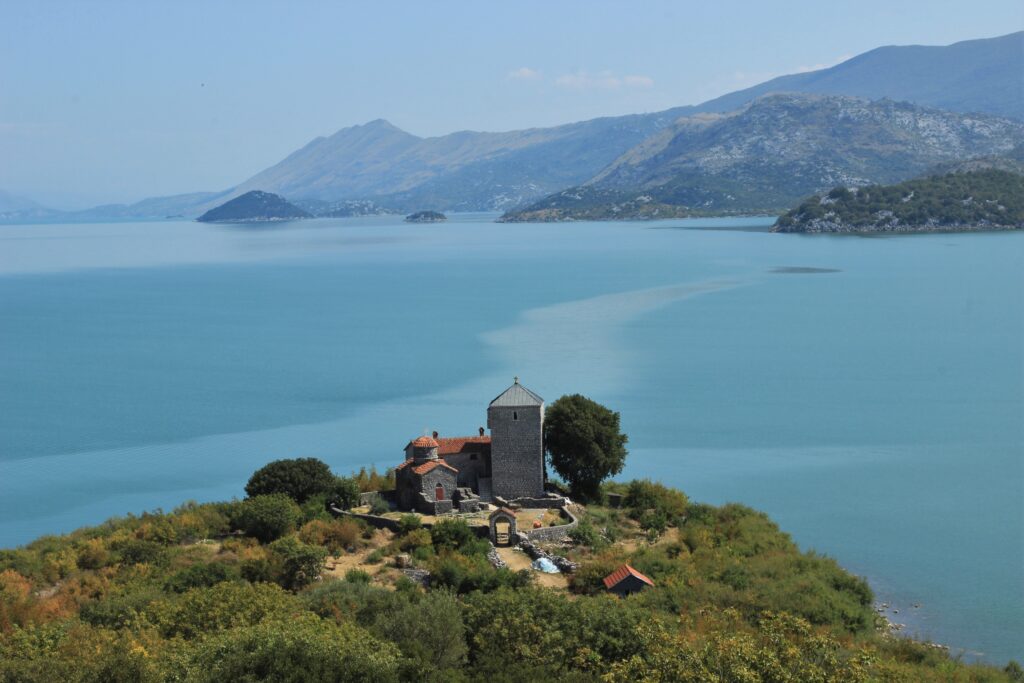
On the lake’s islands, isolated monasteries were long places to seek sanctuary or escape: Beška, the 14th century home of Balšić widow Princess Jelena, and Kom, a 15th century monastery with remarkable frescoes where the poet-prince Njegos was ordained.
The lake basin is also home to Plantaže, Montenegro’s largest winery, producing 17 million bottles a year from vineyards near the shore. The last King of Montenegro reportedly decreed that every Montenegrin should plant vines at their home. Looking out across the shores today and seeing vineyards at every turn, it seems many of them listened. Visiting a winery near Virpazar is a splendid way to end a day at the lake.
Things to do on Albania’s side of Lake Shkodra
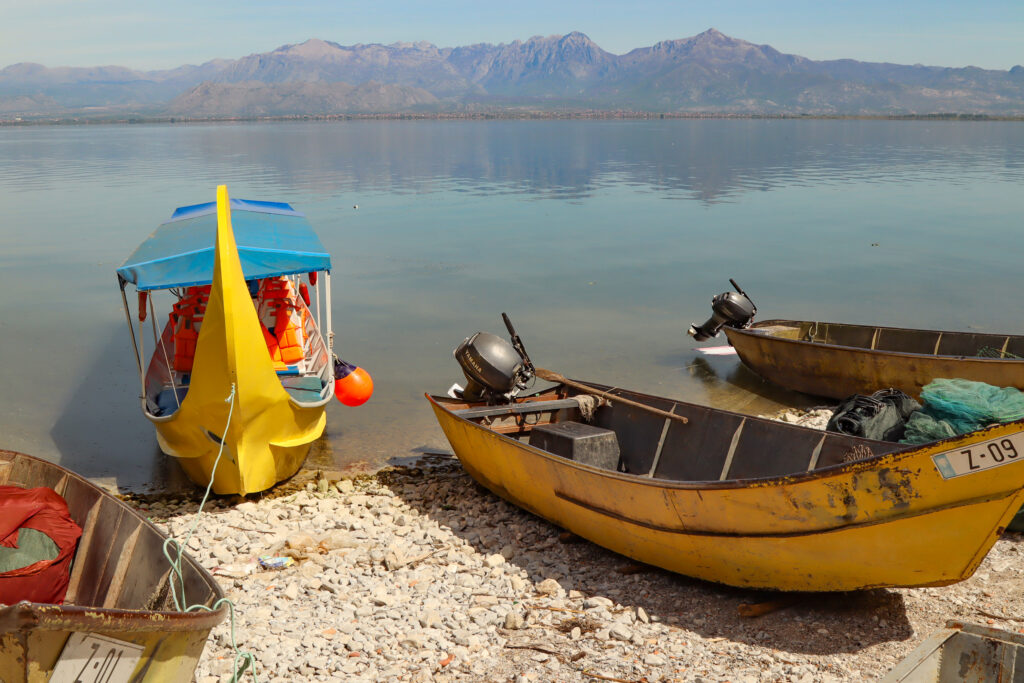
The Albanian shores have a different character entirely. The land is flatter, the lake more open, and the atmosphere more populated with working fishing villages.
Shkodër city, one of Albania’s oldest and most historically significant cities, is the gateway — a fascinating place in its own right, with Rozafa Castle rising above the confluence of three rivers and a lively bazaar where you can scoop up everything from antiques to wool to fresh veg.
Rare for Albania, Shkodër is big on bicycles, earning it the nickname the Cycling City of Albania.
The Albanian side holds the deepest section of the lake, and the history here reflects centuries of Ottoman rule followed by communist-era isolation, when the border between Montenegro and Albania was closed entirely, dividing families and cutting off communities that had been interconnected for generations. That border only fully opened in recent decades.
Boat tours are less common on the Albanian shore, which is partly what makes it feel more raw. It is an excellent destination for cyclists, with a smattering of freshwater beaches popular with locals, especially at Shiroka. The shoreline villages and small fish restaurants here are always welcoming.
Read more about Shkodër in our Undiscovered Guide to the city.
The legend of Rozafa Castle
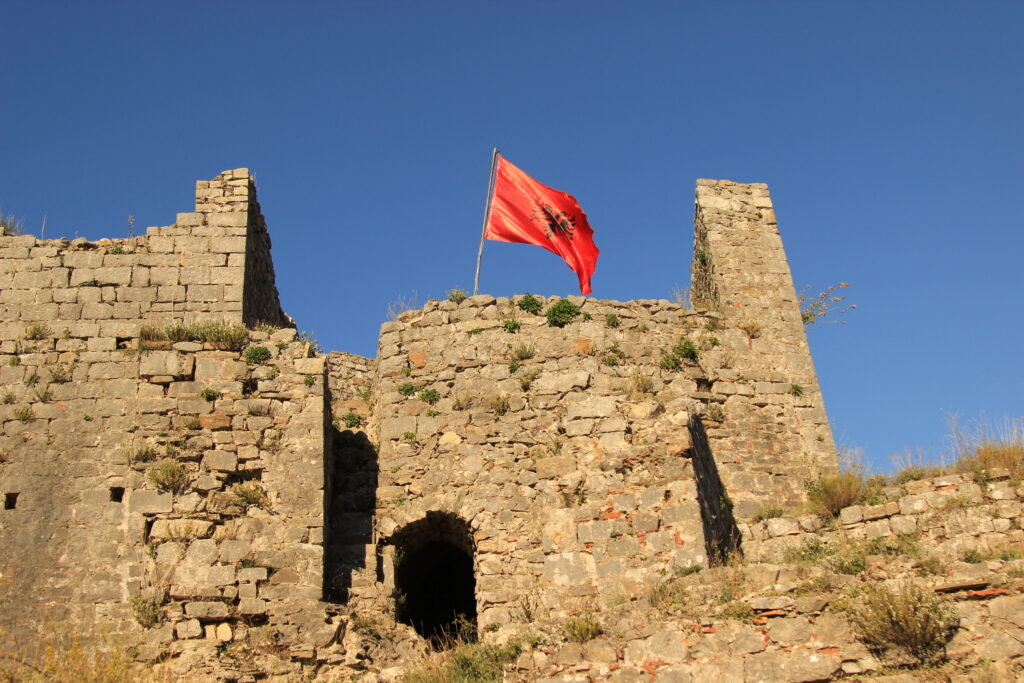
Perched above the confluence of the Buna and Drin rivers, Rozafa Castle has roots stretching back to the Illyrian era. It is also the setting for one of the most remarkable folk legends in the Balkans.
Three brothers set about building the castle, only for the walls to collapse every night. At a loss, they were advised by a wise old man that the only way to make the walls stand was to sacrifice one of their wives and seal her within the foundations. The two older brothers warned their wives. The youngest said nothing.
The following day, the youngest son’s wife arrived with lunch. She was the one chosen. Sealed into the walls, she made a single request: that her right breast, eye, hand, and foot be left uncovered, so she could continue to nurse her infant son. Her name, in the Albanian telling, was Rozafa — and the castle has carried it ever since.
The legend is said to embody the Albanian concept of Besa: the keeping of a sacred promise, even at the most devastating personal cost
The story also appears in the Serbian epic poem Zidanje Skadra, where the woman is called Jelena.
Whether she was Illyrian, medieval Serbian, or entirely mythical depends on who is telling the story and where — which is, in a way, the whole point. These mountains and lakeshores have been home to the same people, mixing across centuries and waves of migration, regardless of what names empires have placed on the maps around them. The walls of Rozafa Castle have seen all of it.
Which side of Lake Skadar is best to visit?
Try Montenegro if this is your first visit to the lake, you want easy access to boat trips and kayaking, or you are combining the lake with Montenegro’s coast or mountains, like on our Super Active Montenegro Holiday.
Choose Albania if you are already exploring northern Albania and Shkodër, you want a town-and-lake combination- like on our North Albania Activity Holiday – or you are interested in cycling the shoreline.
Best of all: experience both. The lake makes far more sense as a single place, and crossing between the two shores — as the pelicans do, without any regard for the border — is one of the best ways to enjoy the lake.
Can you take a ferry from Montenegro to Albania across Lake Skadar?
At present, there is no ferry but we get special permission for our cross-border kayaking trips. to traverse the water from Montenegro to Shkodër in Albania.

Visit Lake Skadar/Shkodra with us
Lake Skadar National Park, in Montenegro, is the place that inspired our founders, Ben and Emma Heywood, to change their lives and set up a holiday business in 2008. The lake is central to several of our trips: from our Lake Skadar Activity Holiday, to our North Albania Adventure Week, or our Montenegro Paddlesports Retreat. If you’d like to explore both shores with expert local guides, get in touch and we’ll help you plan it.
Ready to explore Albania and Montenegro? Browse our range of small group Albania trips and Montenegro adventure holidays – or get in touch to build a tailor-made itinerary around wild swimming, hiking, and extraordinary nature.