
Bosnia and Herzegovina on an Undiscovered Balkans road trip across the countryside: instead of doing the classic Sarajevo to Mostar route, we opted to stay in towns like Konjic and Blagaj, all the while driving through mountains and along brilliant blue rivers.
Bosnia and Herzegovina is a country of pure mountains and more waterfalls than anywhere else in Europe. Its roads and hiking trails wind through magical landscapes of alpine peaks, natural rainforests, rugged canyons and tiny villages wrapped in mist. The 1990s conflicts sadly meant that the country’s wild beauty remained hidden for decades, but today, Bosnia is as accessible as anywhere in Europe.
Below, we’ve gathered three incredible Bosnia adventures beyond the main cities of Mostar and Sarajevo – from panoramic peaks and canyon-edge paths to city escapes and waterfalls galore.
The below adventures are all found on our local-led Bosnia trips.
Adventure 1: Tjentište Spomenik, hiking in Sutjeska National Park
It’s hard to describe just quite how magnificent the Tjentište Spomenik is, both viewed from a distance and up close. It’s a spangling white-and-dark mass of concrete, full of sharp brutalist edges and hidden sculptures, that melds with the mountains behind it. It’s the most dramatic monument I’ve ever seen. Read on to see what’s around the monument…
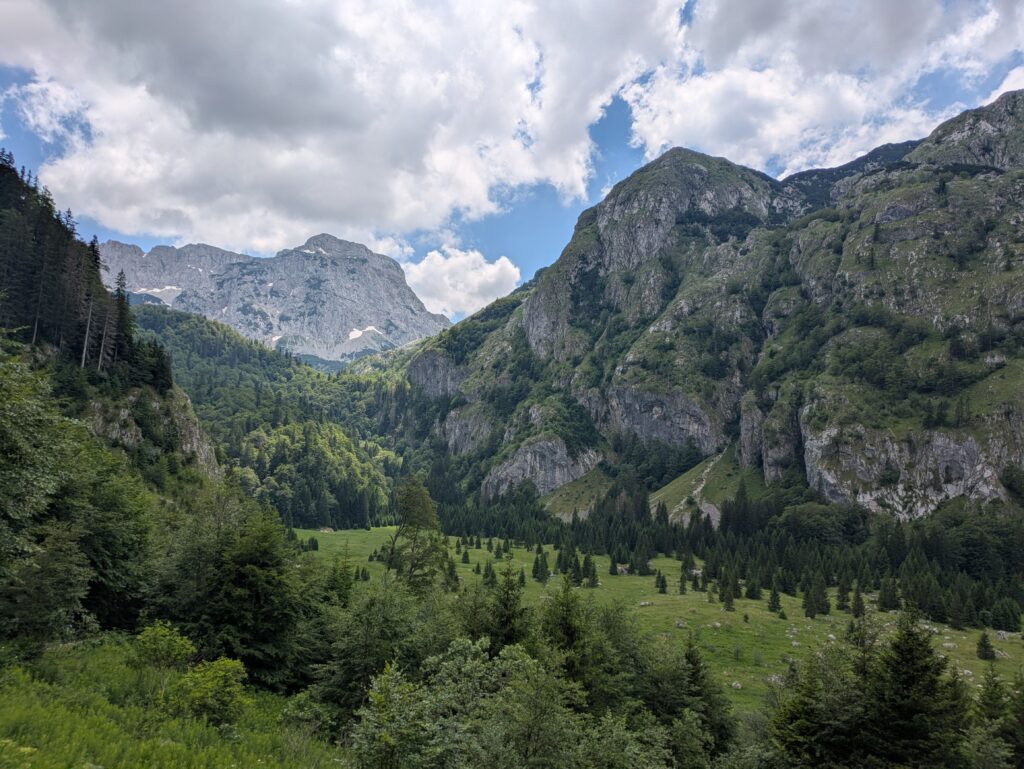
Sutjeska National Park sits in the heart of the Dinaric Alps, and the Tjentište War Monument is about as dramatic an introduction to it as you could get.
The monument itself, those two enormous concrete wings rising out of the valley floor, stands against a backdrop of the Maglić and Volujak massifs, with the Perućica primeval forest just to the north, one of the last remaining primary rainforests in Europe, and the turquoise Sutjeska River cutting through the gorge below.
A personal favourite moment was when dusk fell in Sutjeska and the landscape around Tjentište War Memorial sparkled with fireflies.
You need a 4×4 to drive the bumpy unpaved track from the Tjentište War Monument to the start of the Trnovačko Lake hiking route at Prijevor (1,659m). It’s hard to get lift up here unless you’re with a tour company, which is why on our Bosnia hiking trips use a local driver-guide.
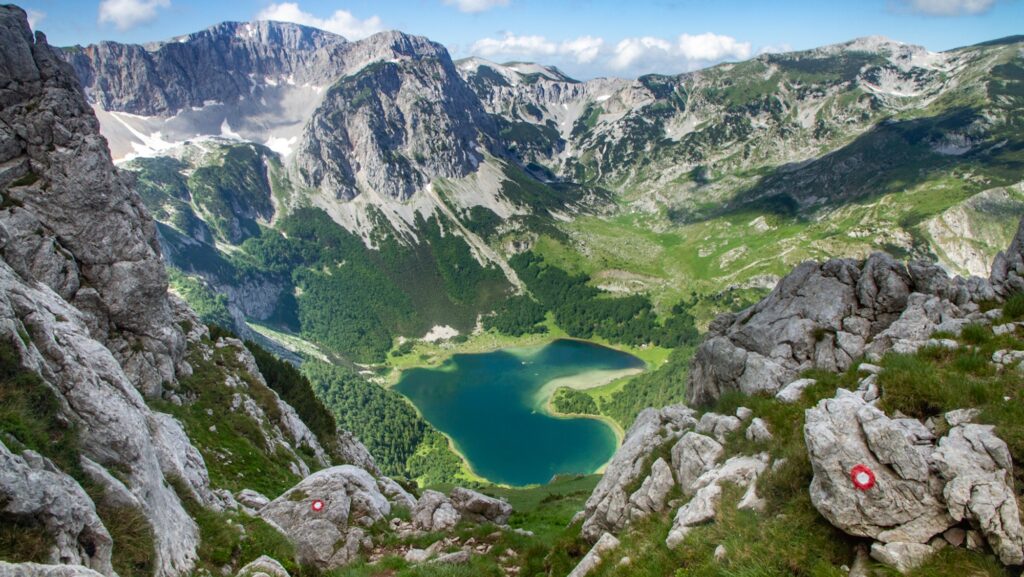
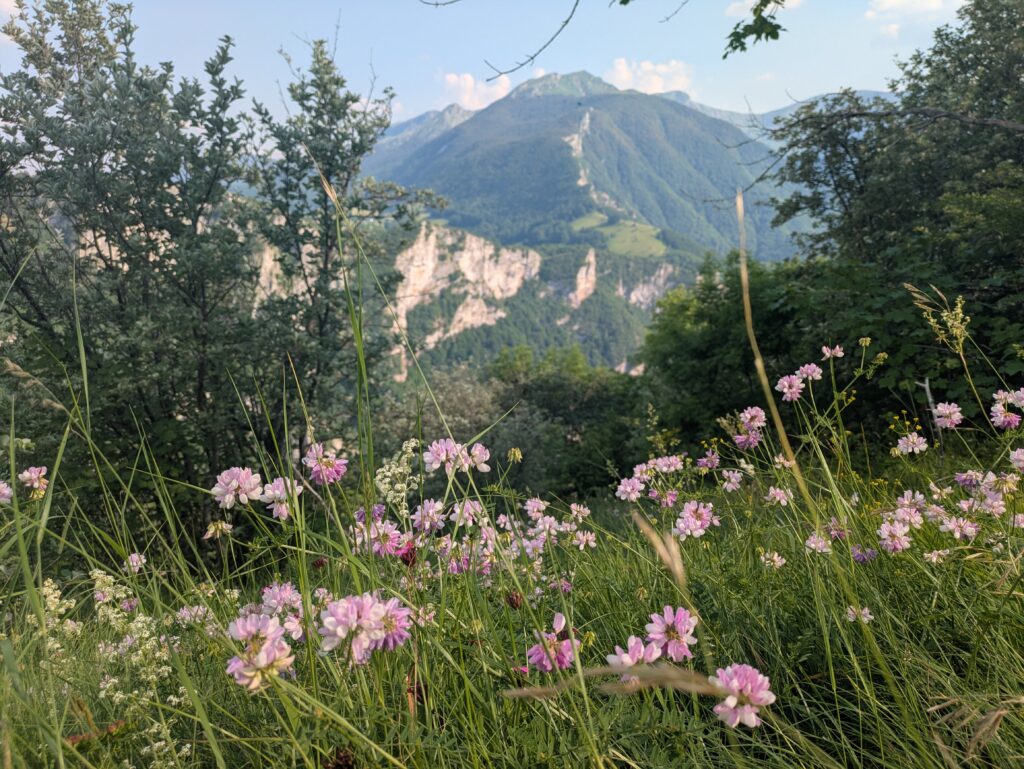
Driving first to Prijevor, we hiked through sheer mountains before coming to a flower-filled meadow. From here it was a 90-minute hike to Trnovačko Lake, a heart-shaped lake with wild horses roaming around it, and a little coffee hut.
We didn’t climb all the way up to Mount Maglić, Bosnia’s highest peak at 2,386m (although it’s technically in Montenegro) as this is an additional 3 hour demanding hike. Worth it if you’re with an experienced guide – otherwise it’s tricky to navigate!
We cover Sutjeska National Park on days 2,3 and 4 of our Bosnia hiking holiday.
Adventure 2: Beyond Mostar, Blagaj, Neretva river and Konjic
We raft on the Neretva river on Day 2 of our Bosnia Activity Holiday. before basing our guests in Blagaj for three nights.
Our drive from Sutjeska to Blagaj was a stunning compression of Herzegovina’s geology into two hours. The road folded through ridge after ridge of grey-green mountains, then climbed through a forested valley onto the karst plateau of eastern Herzegovina with its pale lunar landscapes of big skies and distant ridgelines. The town of Nevesinje appeared as a sudden green polje, with stone sheepfolds and farmland ringed by peaks. Beyond it, the descent toward Blagaj was equally dramatic: karst gives way to gorges and sudden lushness as the Buna River bursts from the cliffs.
The village of Blagaj was a lovely place to stay, especially right by the river…
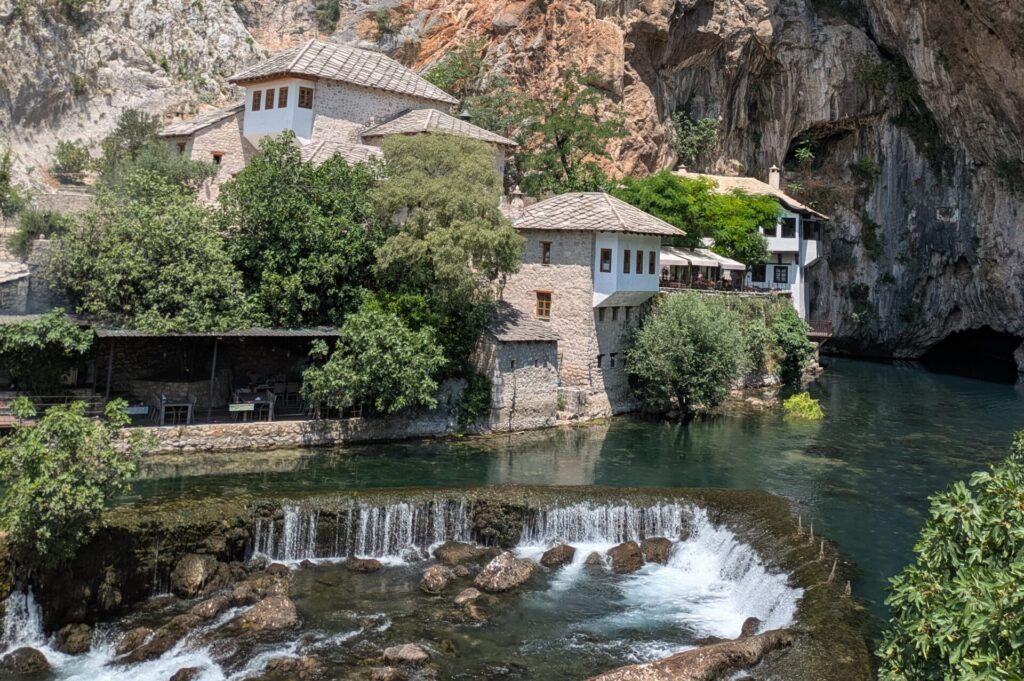
After a few minutes (or hours) in the hammock we roused ourselves to do some sightseeing at Blagaj Tekija, a 16th-century Sufi dervish monastery perched at a cliff’s base beside the Buna river.
Built around 1520 by Bektashi dervishes, the Tekija drew pilgrims for its shrine to the Sufi mystic Sari Saltuk. Repeatedly damaged by rockfalls and rebuilt, it was shuttered under communist rule, then revived in the 1970s. Restored in 2012, it also somehow survived the 1990s Balkan War untouched. Today, you can wander its modest stone rooms with their colourful ćilim rugs and drink a fresh pomegranate juice by the water.
The mystery of the Buna River’s source
Scientists have tried and failed to find the Buna river’s real source for years. Divers have explored the karst cavern to roughly 30 meters, but its underground course stretches far deeper through unmapped channels, meaning its true origin remains unknown.
Neretva river drive
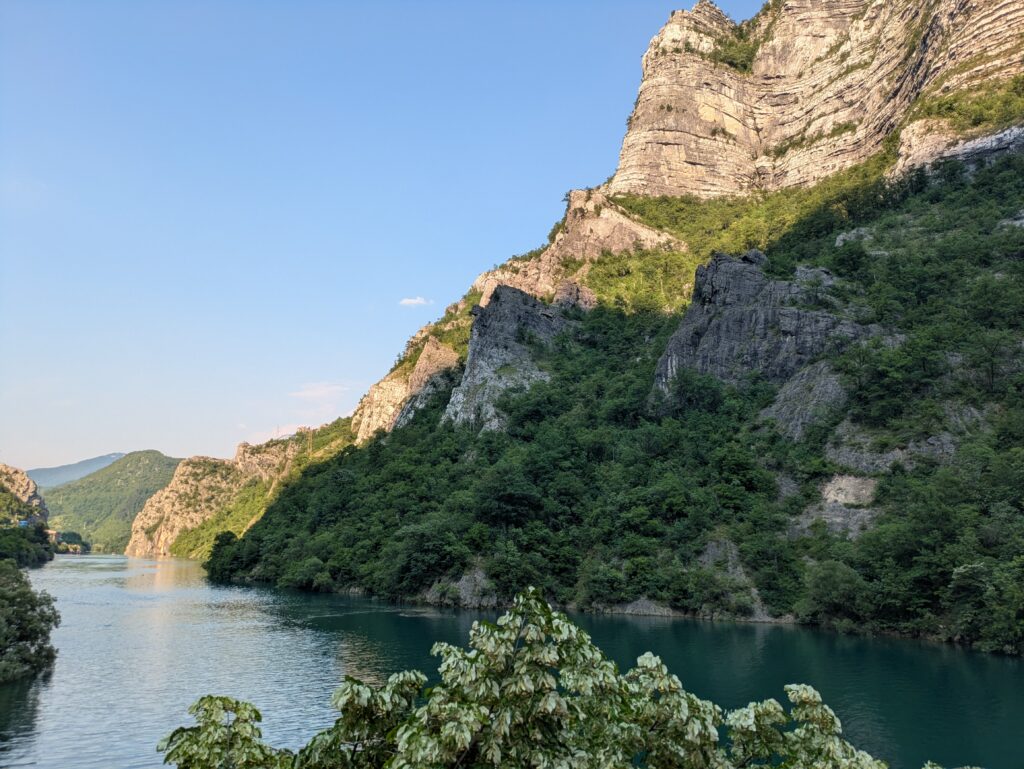
Leaving Blagaj we drove through Mostar to Jablanica. The road hugs the Neretva River as it carves through limestone canyons, narrowing and widening in turns. We ate fresh trout at a cute restaurant with a wooden terrace over the Neretva.
Approaching Jablanica, the canyon opens toward the lake framed by more mountains. Jablanica Lake was a great swimming stop and far fewer crowds than coastal alternatives, plus you can potter about on splav boats.
15 minutes from Jablanica, Konjic is a charming alternative to Mostar with its graceful Ottoman stone bridge over the Neretva, scenic hillside trail above the town, and an authentic, unhurried, distinctly local atmosphere. We stop here before rafting the Neretva river on Day 2 of our Bosnia Activity Holiday.
Related:
- Meet Skender, our adventure guide in Bosnia and Herzegovina
- What to see and do in Sarajevo
- 7 Balkan alternatives to the best hikes in Europe
Adventure 3: Socks from the knitting grannies of Lukomir village
In Bosnia’s highest village, 1,495m up on Bjelašnica, grannies still hand-spin and dye wool and knit thick priglavke socks by their stone homes. Each pair takes about five days to make. Once survival gear for shepherds, the warm socks now sustain the semi-nomadic community by selling them to hikers. I bought several pairs for family Christmas gifts!
We visit Lukomir on day 7 of our Bosnia hiking holiday and as an optional hike on our Bosnia activity holiday.
Lukomir loop hike & Rakitnica Canyon in Bjelašnica
A moderate to tough day hike near Sarajevo that links Bosnia’s highest village of Lukomir with Umoljani village, offering stunning views over the Rakitnica River canyon and traditional stone houses. Lukomir means “harbour of peace” in the local dialect. Here you’ll find 600-year-old traditions still kept including socks and excellent Bosnian coffee.
You can also visit the medieval Stećci tombstones which date from the 14th century and show this high altitude region has long been inhabited.
This is part of the Via Dinarica White Trail which snakes its way across Bosnia’s most mountainous and rugged terrain. It’s a long distance trekking route and sections can be tackled individually or in one go as a deep immersion in the Dinaric Alps. The section through Bjelašnica is within a stone’s throw from Sarajevo and we visit on our Bosnia hiking holiday.
Or, discover more of the Via Dinarica routes on an extraordinary 7-day hiking tour from Montenegro to Albania, with 54kms of rugged beauty, remote trails & incredible nature.
FAQs:
When is the best time to go hiking in Bosnia?
Most mountain routes are best from late spring to early autumn (late May–October). Snow can linger on higher peaks and north faces into early summer so always check with locals before heading out on a trail. Lower level trails can be hiked year-round.
Weather can change fast in the mountains — always carry layers, a waterproof, good boots, and plenty of water.
What are safety tips for hiking in Bosnia?
If you’re taking a 4×4 journey up a bumpy trail, opt for an older or female driver. Young male drivers in the Balkans tend to be reckless. Luckily at Undiscovered Balkans we are mature, sensible and 50-50 male female so you can count on our driving!
While most routes above are mapped out, they may not be as clear as some of the more established hikes in Europe and it is easier to get lost, particularly in more remote areas where there are fewer people (and English-speaking at that) to ask directions of.
Mountain rescue services do exist, but are not as well-funded or resourced as in the west. That’s why all of our hiking holidays are led by qualified mountain guides who know the routes like the backs of their hands.
Sticking to marked trails is important. Some areas once saw conflict and had residual mines, though all the trails we go on are well-trodden; check with local guides or clubs for up-to-date trail info if you’re planning to head off the beaten path.
Other than that, people in the Balkans are incredibly welcoming and crime is very rare in the mountains.
Feeling inspired? Sign up to our monthly newsletter to get more exciting adventure travel tips for Bosnia and beyond, and hear first about our best offers across the Balkans.
Comments