
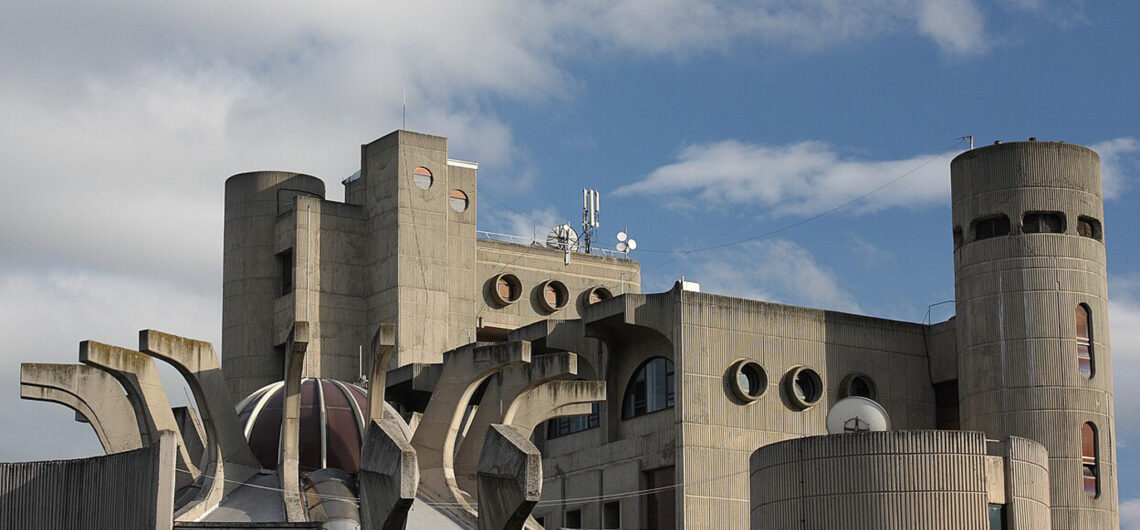
Across the cities of former Yugoslavia, striking concrete buildings in a style known as brutalism rub shoulders with more classical European or Ottoman architecture. Some people think the Yugoslav legacy is ugly, others love it. There’s even a cult following devoted to old brutalist buildings on social media. We love the mix of both – cobbled lanes of old bazaars, elegant church towers and mosque minarets, and then an interesting sculptural lump of concrete next door!
Between the 1960s and the 1980s, Yugoslav architects were handed large budgets, prominent sites and an unusual amount of creative freedom, and they built a new form of brutalist architecture. What they produced still stands in town squares, on hillsides and along the Adriatic coast, housing department stores, churches, libraries, spas and apartment blocks that people use every day.
We’ve written before about the spomeniks, the abstract war memorials scattered through forests and national parks across the region. This piece covers the buildings that came out of the same decades and the same ambition, including several you’ll pass on our routes and one or two that justify a detour of their own.
Montenegro: brutalism by the coast and in the mountains
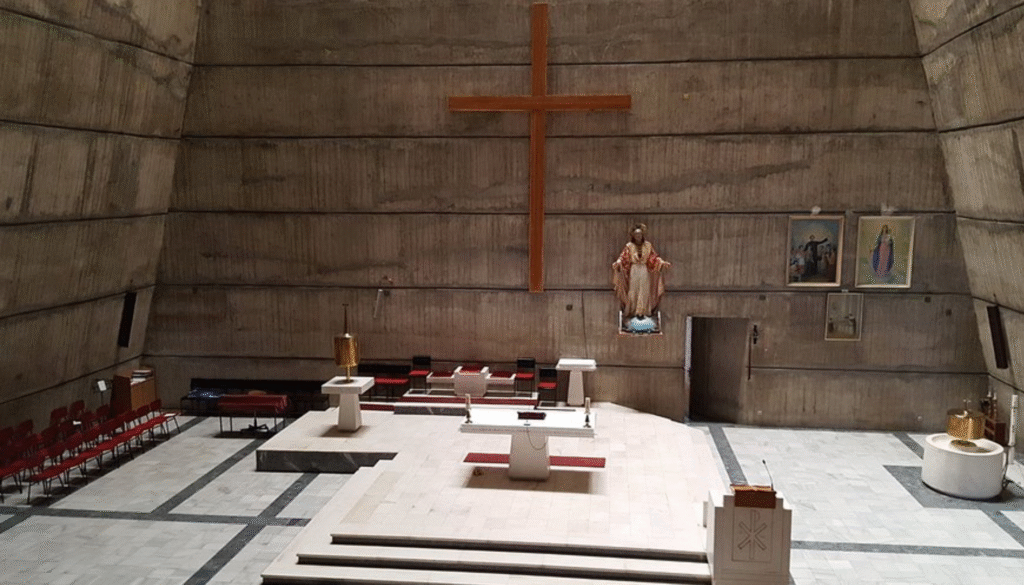
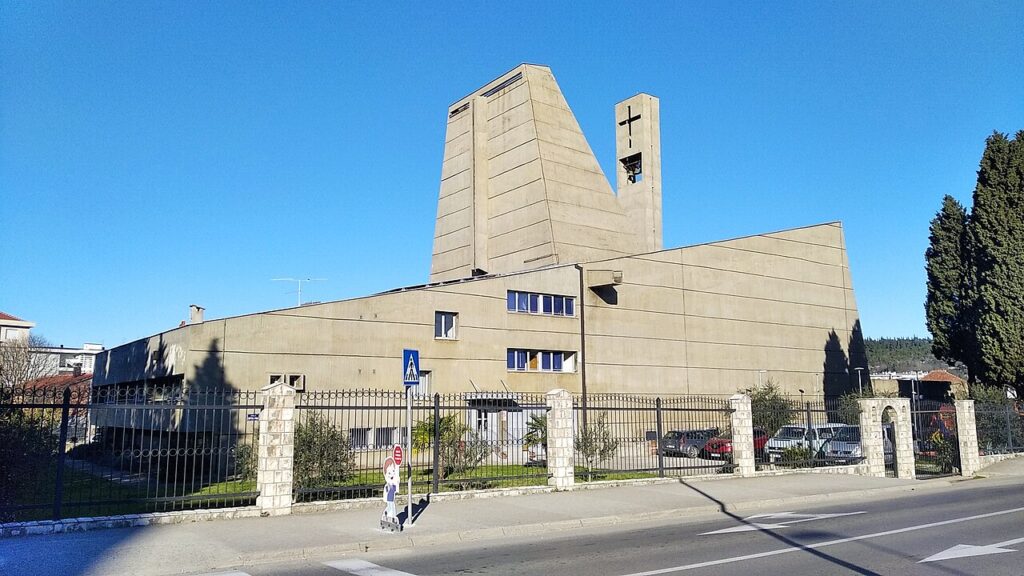
Church of the Sacred Heart of Jesus, Podgorica. Built: 1969
Podgorica’s only Catholic church was designed by Zvonimir Vrklja to resemble a ship, its hull of raw concrete rising to a 40m freestanding bell tower with a spiral staircase inside. The facade was never finished. Inside, the space is dark until a 25m light shaft drops a column of daylight onto the altar. Vrkljan taught architecture in Zagreb and built this for the city’s Albanian Catholic community after the original church was destroyed in the Second World War.
Most visitors pass through Podgorica on arrival or departure, which makes this an easy add on.
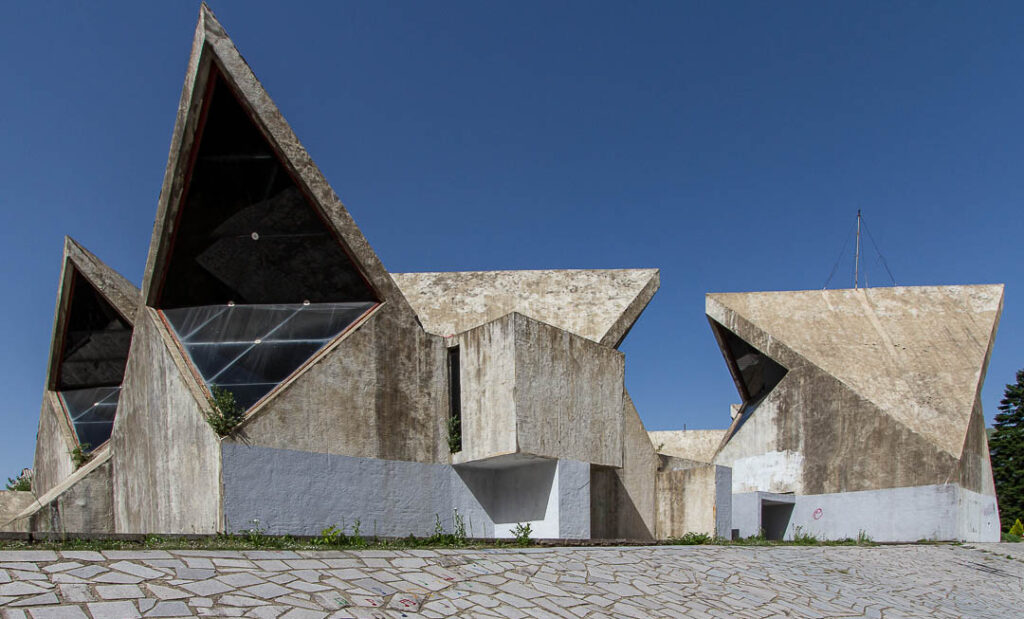
Kolašin Memorial Centre (Spomen-dom), Kolašin, Built: 1971 to 1975
Marko Mušič was 30 when he won the competition for this building in 1970. He designed a bank of sharp concrete pyramids, roofs pitched steeply the way Dinaric mountain houses are pitched to shed snow, and set them in the middle of a small mountain town. It commemorates the first Montenegrin anti-fascist assembly, held in Kolašin in November 1943, and it still houses municipal offices, though the main assembly hall has been left to water damage and weeds. MoMA exhibited it in 2018. It came second in a World Monuments Fund restoration competition in 2017.
Kolašin is the starting point for our Montenegro and Albania hiking tour, so guests arrive the night before and can walk over before dinner. Kolašin is also the base for our 7-day Montenegro winter activity holiday.
Access: In the centre of Kolašin, a five minute walk from the main square. The exterior can be viewed at any time. Much of the interior is closed.
Robna Kuća Izbor, Bar, Built: 1980 to 1984
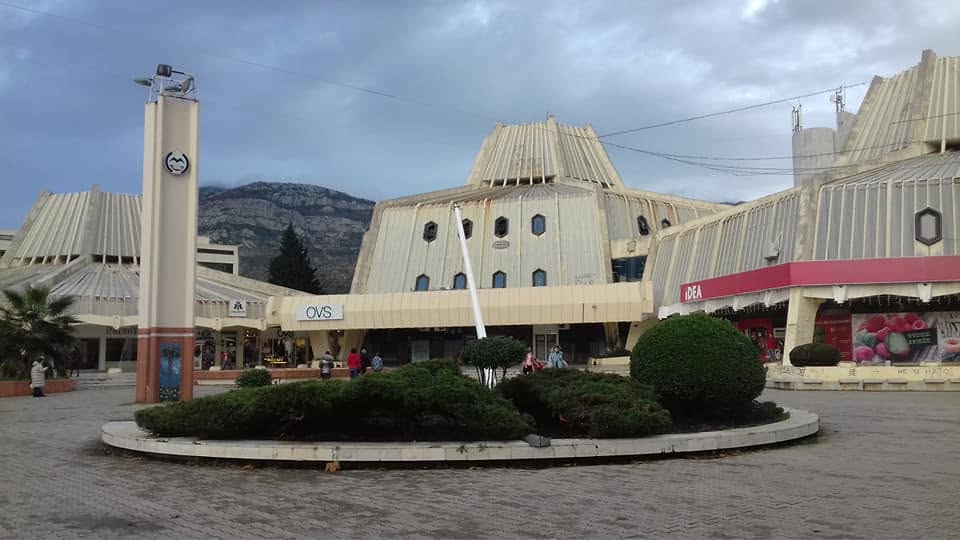
Three concrete domes sit on the main square in Bar like something that landed there from space. Batrić Mijović designed them as a department store, engineering the loads onto columns so that the interior could open up into one uninterrupted retail floor, an ambitious solution for Montenegro in the early 1980s. The domes were shaped to echo the profile of the mountains behind the town. A fourth, down the road, now houses the local tourism office.
Access: On the main square in Bar, ten minutes from the seafront. Fifteen minutes from Villa Miela, the base for our Lake Skadar activity holiday.
Bosnia & Herzegovina: brutalism in the heart of the Balkans
Historical Museum of Bosnia and Herzegovina, Built 1963
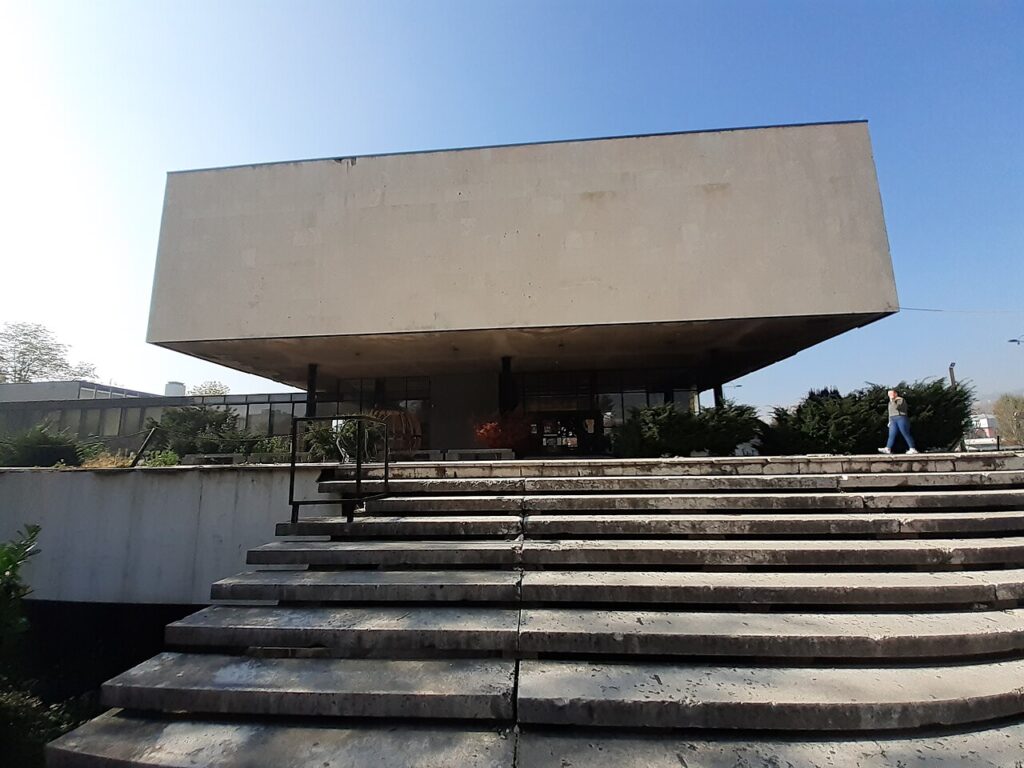
In the heart of Sarajevo’s commercial quarter, between several shopping malls, the US Embassy and a National Museum, the Historical Museum stands out as a modernist building with a cubic upper floor supported by metal columns and glass. It was founded at the end of the Second world war in 1945, but the brutalist structure you see today was built by Yugoslav architects Boris Magaš, Radovan Horvat, and Edo Šmidihen. The museum began life as the Museum of the Liberation of Sarajevo in 1945 and was shelled during the 1990s Balkan war. It has a collection of 400,000 artefacts relating to the Second World War, the Socialist period and the 1990s war.
On one side there is a mural, showing the destruction of Sarajevo during the four-year siege of the city that began in April 1992 and ended in February 1996.
Access: Marijin Dvor, a ten minute walk from the old town along the main road. We start an end in Sarajevo on our Bosnia multi-activity holiday.
Novo Sarajevo UNIS Towers, Built: 1986, Ivan Štraus
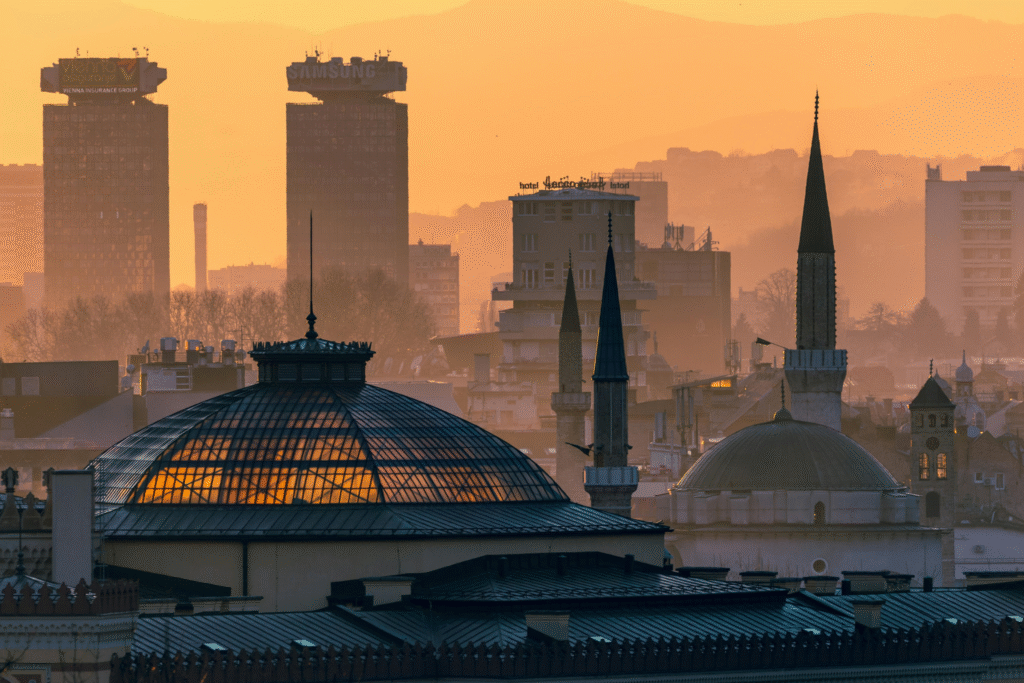
Two 90m glass and steel towers that Sarajevans call Momo and Uzeir, after a comic double act, one Serb and one Bosniak. Both were shelled during the siege and both stayed standing. They were rebuilt from 1999 onwards and now bookend the modern half of the city. Štraus designed much of late Yugoslav Sarajevo, including the Holiday Inn where foreign correspondents were based throughout the war.
Access: Marijin Dvor, a ten minute walk from the old town along the main road. We start an end in Sarajevo on our Bosnia multi-activity holiday.
Serbia: Yugoslav history in Belgrade
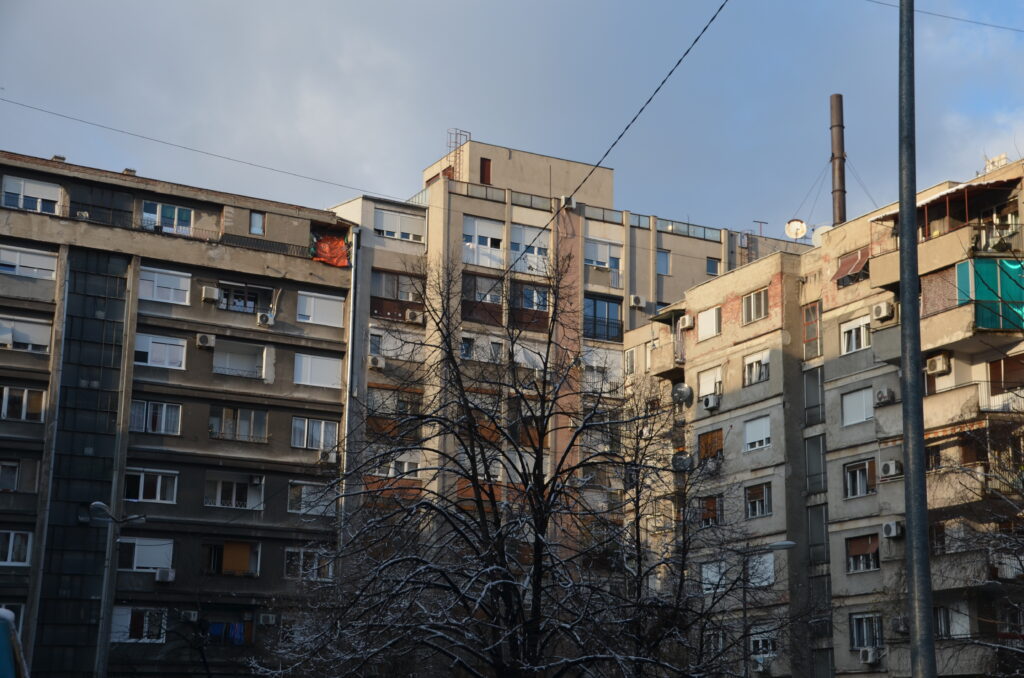
New Belgrade is the largest concentration of socialist era building in the region, and the drive in from the airport takes you past most of the highlights, as we do on our Serbia Activity Holiday, or walk from the town centre, offering scenic views of the city.
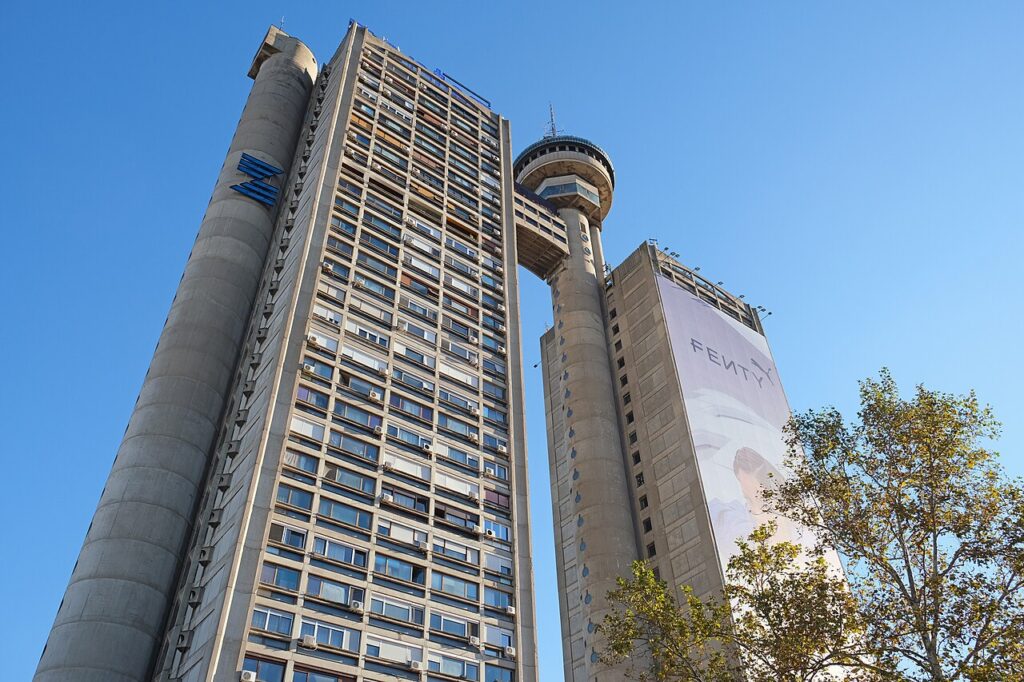
The Western City Gate, better known as Genex Tower, is the one everyone photographs. Mihajlo Mitrović designed it in 1977 and it was finished in 1979: two towers of 30 and 26 floors joined by a bridge near the top, with a cylindrical restaurant crowning the whole thing. The restaurant was built to revolve. The mechanism never worked. It was declared a cultural monument in 2021 and appeared in MoMA’s Yugoslav architecture exhibition.
Across the city, Vera Ćirković’s Eastern City Gate at Rudo puts three 28 floor towers on a hilltop, best seen from below at the end of the day. Stojan Maksimović’s Sava Centar, finished in 1979, still runs as a congress hall and the interiors have been restored. The Museum of Contemporary Art, by Ivan Antić and Ivanka Raspopović, sits on the bank of the Sava in a cluster of crystalline white volumes and holds around 8,000 works.
For the residential blocks, head for Blocks 22 and 23, designed as whole neighbourhoods, with schools, shops and green space built into the plan.
Belgrade is the start and end point of our 7 day Serbia adventure, and a half day is enough to see all of the above.
Croatia: Communism on the coast
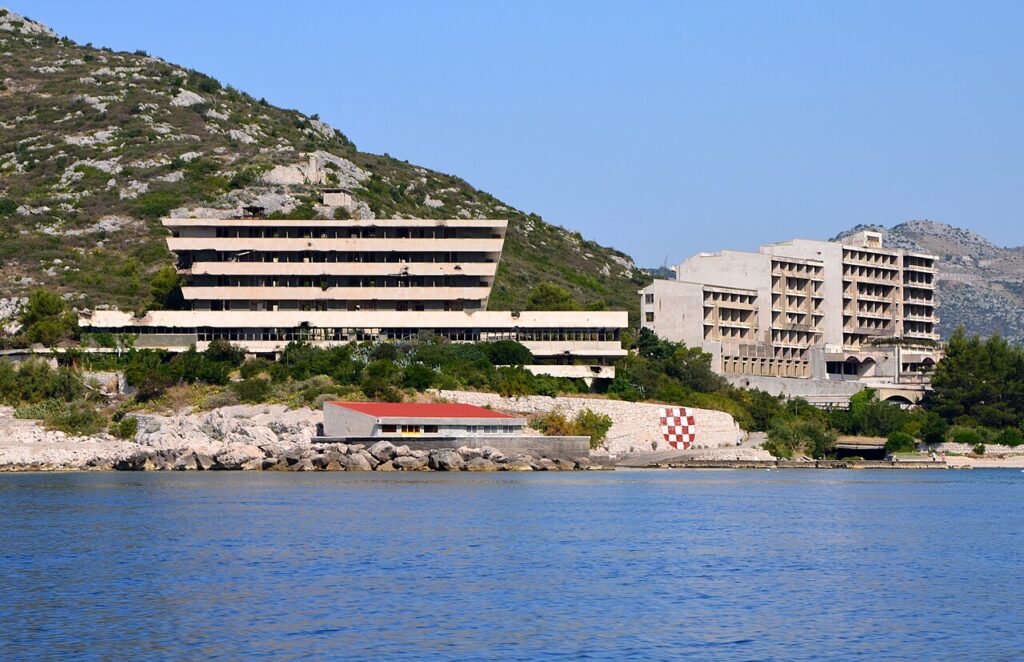
Kupari, near Dubrovnik, Hotel Pelegrin 1963
Five hotels were built in this bay for the Yugoslav People’s Army, and the largest of them, the Pelegrin, was the biggest hotel on the Adriatic when it opened. David Finci stacked 419 rooms across six floors and cantilevered the whole thing over the shoreline. It was shelled in 1991, stripped for materials over the following decades, and MoMA later exhibited it as a landmark of Yugoslav modernism. Demolition began in early 2025 for a resort development, so check what is still standing before you make the trip.
Access: Kupari bay, 20 minutes south of Dubrovnik on the coast road. Kupari is a short detour from our Southern Dalmatia holidays.
If you fly via Zagreb, the city has its own concrete highlights, including the Cibona Tower, the Mamutica housing block, and the National and University Library.
North Macedonia: the ‘Brutalist Capital’ of Europe
Come and see the Skopje, Europe’s brutalist capital, for yourself on our North Macedonia activity holiday.
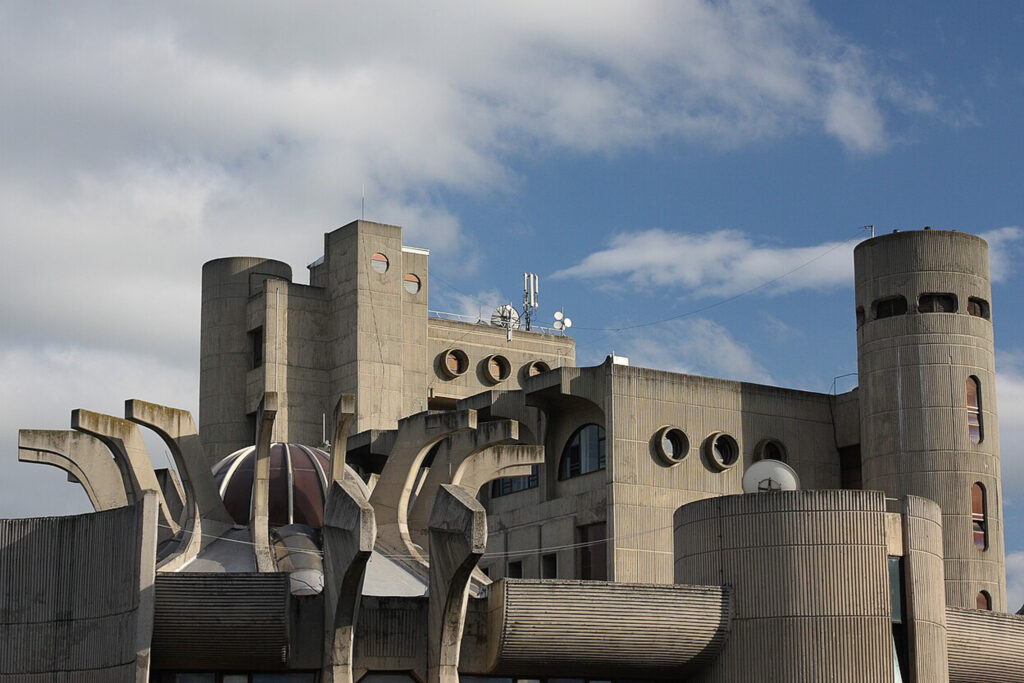
Skopje’s brutalism exists because of catastrophe- a blessing in a tragic disguise. After the 1963 earthquake flattened 80% of the city, the UN ran a rare international reconstruction effort, and Japanese architect Kenzo Tange won the competition to masterplan the new centre. His team blended Japanese metabolist theory with the concrete brutalism popular at the time in Yugoslavia, a combination barely seen anywhere outside Skopje.
Local architect Janko Konstantinov built the most famous result, the Post Office which looks like curved concrete petals. He also completed the Nikola Karev school, while Georgi Konstantinovski gave Skopje its City Library and student dormitories, and Marko Mušič designed the unusual university campus. Most of it sits within easy walking distance of Macedonia Square.
We start and finish our North Macedonia activity holiday in Skopje.
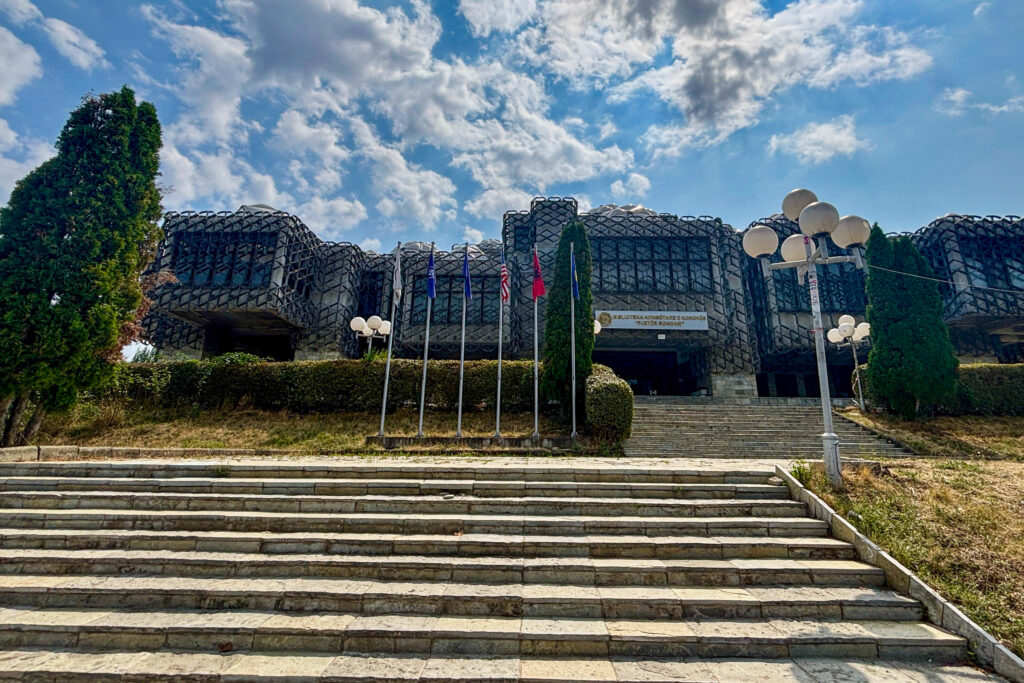
Kosovo, National Library of Pristina
Built: 1982, Andrija Mutnjaković
Access: In the university district in central Pristina, a 15 minute walk from the main boulevard. Open to visitors during library hours.
Ninety nine domes of different sizes, the whole building wrapped in a metal fishing net. Mutnjaković said he was combining Byzantine and Islamic forms, and drawing on pre-Romanesque building in the Balkans. Locals have read the domes as plis, the traditional white Albanian felt hat, and as a nod to the hamams of Prizren and the Patriarchate of Peć. It has appeared on more than one list of the world’s ugliest buildings, which has only made people more determined to come and photograph it more.
We spend time in Pristina on our Kosovo activity holiday.
FAQs
How to plan a Balkans holiday around Yugoslav architecture?
Why does Yugoslav brutalism look so unusual?
Three main reasons. First, designers were briefed to create something that would not offend any ethnic or political group in the complex post-war Yugoslav federation. Second, Tito deliberately wanted to distance Yugoslavia from Soviet-style monumental art. Third, abstract and modernist design was simply the dominant architectural fashion of the era.
Can I visit them as part of an organised trip?
Absolutely. Undiscovered Balkans incorporates key spomenik-monuments into several trips, including our Bosnia Hiking Holiday, Bosnia Activity Holiday, Montenegro Activity Holiday, Lake Skadar Villa Holiday, and Serbia Activity Holiday.
Feeling inspired? Subscribe to our free monthly newsletter for more travel-inspired tips about the Balkans, first dibs on our offers and tours, and our special subscriber discount.
Comments