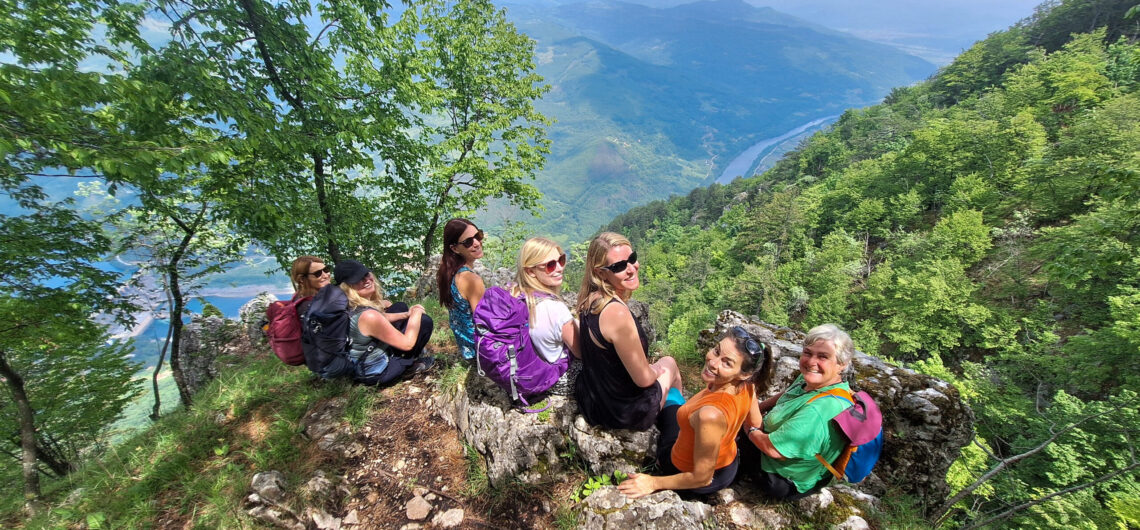
Serbia is one of the Balkans’ best-kept hiking secrets, with great mountain trails that rival Montenegro, Bulgaria or Albania. From the Eagle Canyon to the Stara Planina – an ancient range stretching all the way to the Black Sea, and the Zlatibor range on the Serbian-Montenegrin border, hiking in Serbia has much to offer.
Like most Balkan hiking destinations, tourism is still in its infancy here so most often you will have all that spectacular scenery to yourself. Village guesthouses dot the mountain routes and it’s here you’ll find the authentic taste of Balkan mountain culture and hospitality.
Read on to discover the best hiking trails in Serbia, all featured in our guided Serbia holidays. And don’t miss the video below showing some of the beautiful places we explore!
Stara Planina, Serbia’s ‘Old Mountains’
Eastern Serbia is largely uncharted territory by foreign tourists, including the Stara Planina range which stretches 550 kms from Serbia to Bulgaria. The name ‘old mountains’ suit it in more ways than one – people still live a traditional way of life in stone villages with small family farms. Expect to find homemade rakia and every kind of pickle stored in the house!
The area is dotted with naturally occurring karst waterfalls and the ruins of Felix Romuliana: a UNESCO World Heritage Site and ancient Roman palace complex built by Emperor Galerius. Worth a detour on your way in or out.
We explore Stara Planina on our 7-Day hiking holiday in Serbia, rambling around waterfalls and serious ridgelines, and, if we’re lucky, spotting some wild horses. This range has it all, from half-day strolls to full summit days.
Midžor Peak — Serbia’s Highest Summit (2,169m)
Distance: 16km
Difficulty: Moderate, 6–7 hours at a comfortable pace. No scrambling, no ropes, just good boots and stamina. We do it on day 6 of our Serbia hiking holiday.
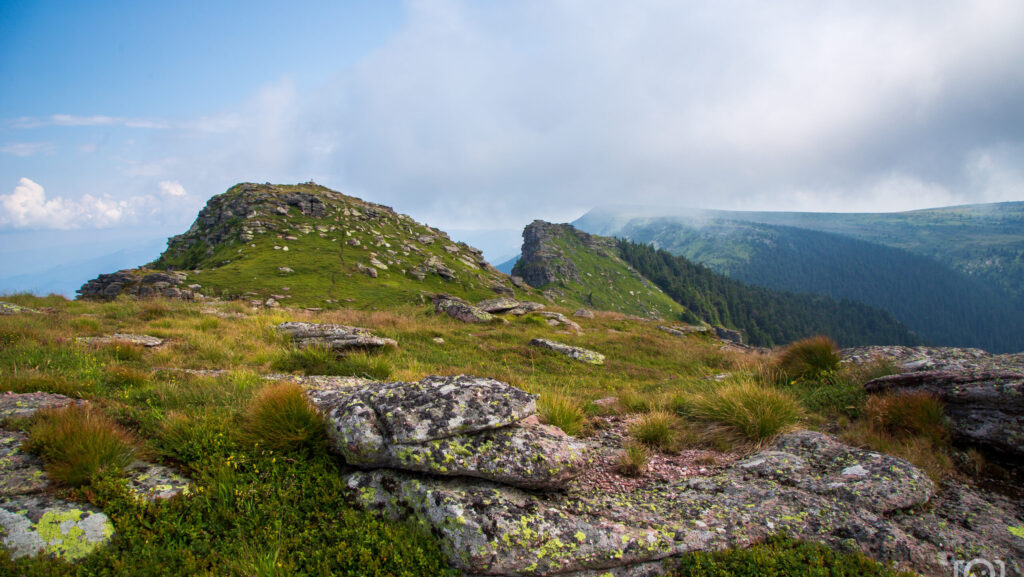
This classic route makes Midžor is Serbia’s highest peak (2,169 m) surprisingly accessible for a mountain of its size. The 16 km round-trip route starts at the Babin Zub (Grandma’s Tooth) area, named after a large rock above the village that does, genuinely, look like a tooth.
The trail follows a steady, 700m climb through alpine meadows and open ridge terrain with no technical sections to worry about.
At the summit, perched on the Serbian–Bulgarian border, you’ll be rewarded with sweeping views across both countries, and on a clear day you can see as far as the Carpathians in Romania.
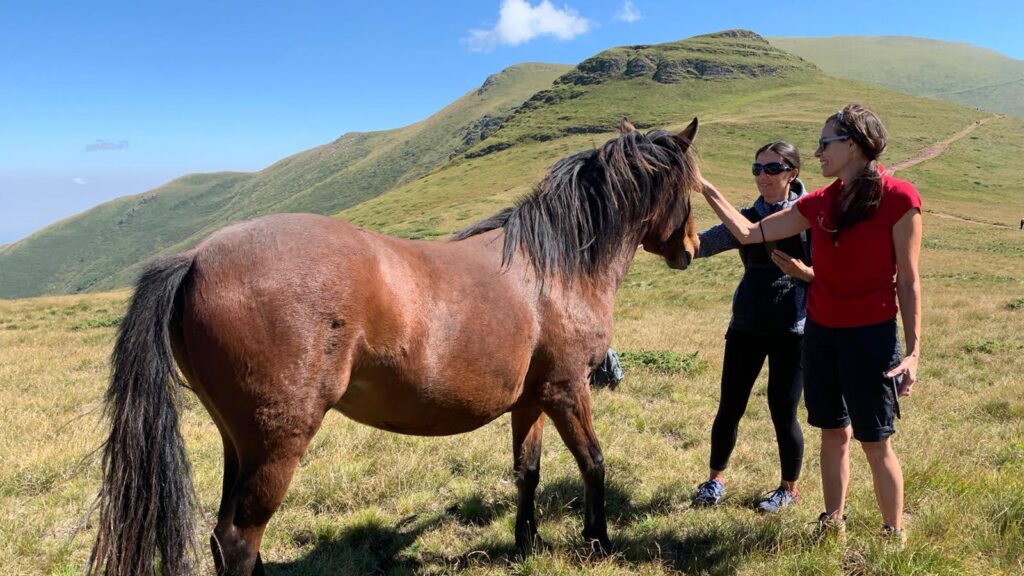
The upper slopes are also famous for their semi-feral herds of horses that roam around. Don’t be tempted to ride one back down!
Tri Čuke — Three Peaks on the Bulgarian Border
Distance: 16km
Difficulty: Moderate to difficult
Less visited than Midžor and all the better for it. Tri Čuke (The Three Peaks) is one of those trails where you’ll likely have the mountain all to yourself. We do it on day 4 of our Serbia hiking holiday.
The day typically begins at the village of Dojkinci, itself a lovely, sleepy place, and a stop at Tupavica Waterfall before the trail opens up onto wide ridges that trace the border with Bulgaria. It’s half forest, half open mountain, with big views and a genuinely remote feel throughout. The highest peak is (1,937m).
Goat’s Rock (Kozji Kamen) waterfall hike in Serbia
Distance: 8km
Difficulty: Easy
A shorter option in the same area: an 8 km return hike to a viewpoint high above Zavojsko Lake, an unusual body of water formed after a 1963 landslide blocked the Visočica River valley. It’s a good half-day option that still delivers on views, and pairs well with a visit to the nearby Bigar Waterfall and the 13th-century Monastery of St. Onufrija (a very manageable 2.5 km return walk).
Related:
- The Undiscovered guide to Belgrade
- Beyond Belgrade: Uncovering Serbia one hike (and rakija) at a time
- 6 things you probably didn’t know about Serbia
Tara National Park — Western Serbia
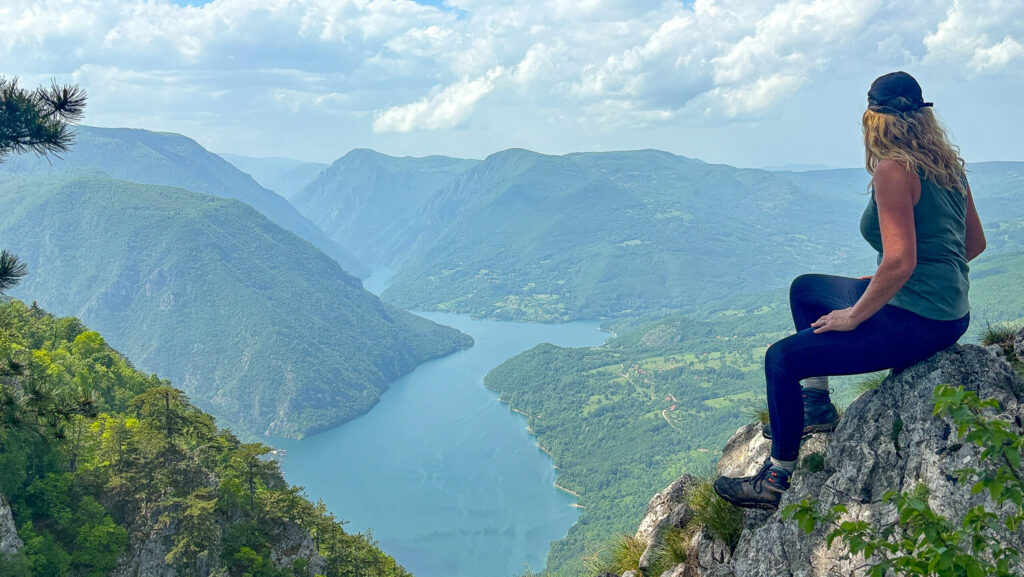
Distance: 12km
Difficulty: Moderate
Tara in the Dinaric Alps in the westernmost corner of Serbia and is widely considered the country’s finest national park, an area of 220 km² (85 miles²) around Tara Mountain.
It’s home to the rare Serbian spruce (Picea omorika) which is believed to have survived the ice age, as well as brown bears, wolves and lynx. In winter, Zaovine Lake freezes dramatically and the landscape could almost be Canada.
Being just a few hours’ drive from the capital of Belgrade, many families escape the city for a weekend of walking and cycling beneath its ancient forest canopies.
The classic day hike covers 12 km, winding through woodland and meadow before arriving at Banjska Stena, a clifftop viewpoint where the Drina River gorge drops sharply away below you. from here, Bosnia is visible on the opposite bank. (You can even hear the call to prayer from the mosques over there).
The loop section adds around 4 km and about 2 hours onto the route. It’s a varied, satisfying hike that gives you a proper taste of what makes Tara special.
Hike in Tara National Park and meet a family who quit modern life to live off-grid there on our 7 day Serbia adventure.
The Gradac River Hike
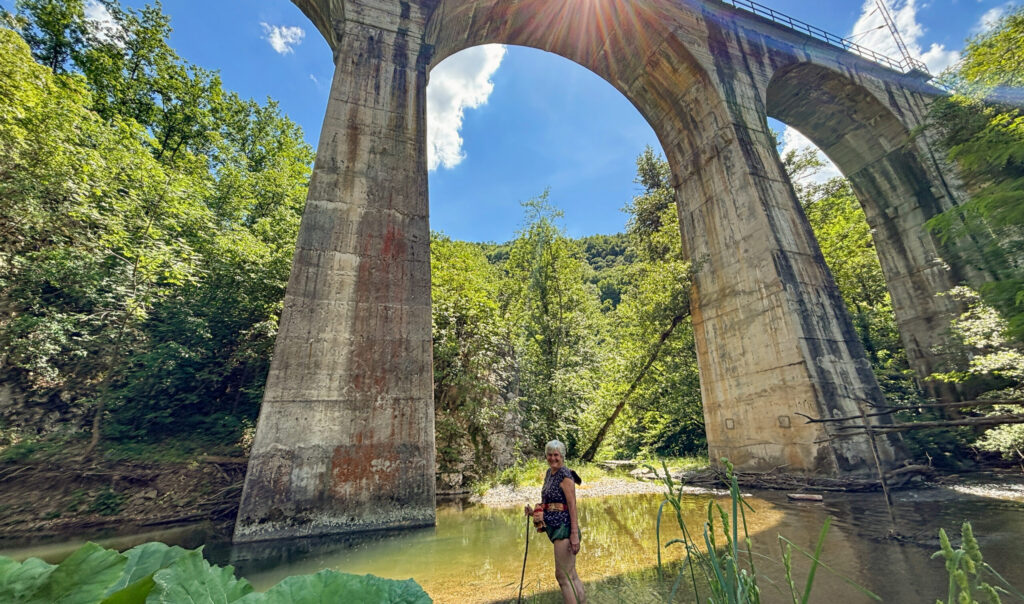
Distance: 8.5–9 km from monastery to river source & back
Difficulty: Easy to moderate route with some rocky terrain and river walking
Full Gorge Trek: The entire gorge is 22.7 km, but most recreational hikes cover the middle section between the monastery and the source.
This hike is a bit different from the mountain routes, and as such we do it on our Activity holiday.
Start near the 13th-century Ćelije Monastery in western Serbia (near Valjevo, roughly 100 km from Belgrade), the route drops down to the crystal-clear Gradac River. This is an area of exceptional natural beauty in western Serbia.
Head into the gorge for 4–5 km of proper river hiking, crossing the stream around 20 times, with water reaching knee height at certain points. Pack dry shoes.
Swimming stops are very much on the cards during the warmer months. The river is known for being extremely clean and is a popular trout fishing spot.
Related:
- 7 Balkan alternatives to the best hikes in Europe
- The 8 best hikes in the Balkans
- 7 of the best national parks in the Western Balkans
Trešnjica Gorge — one of Serbia’s Eagle canyons
Distance: 8km
Difficulty: Moderate. A relaxed circular walk.
The river Trešnjica springs underneath Povlen mountain in Western Serbia and flows into the river Drina. At this confluence, the Trešnjica plunges into 500-metre-deep gorge.We visit on our 7 Day Multi-Activity Holiday in Serbia.
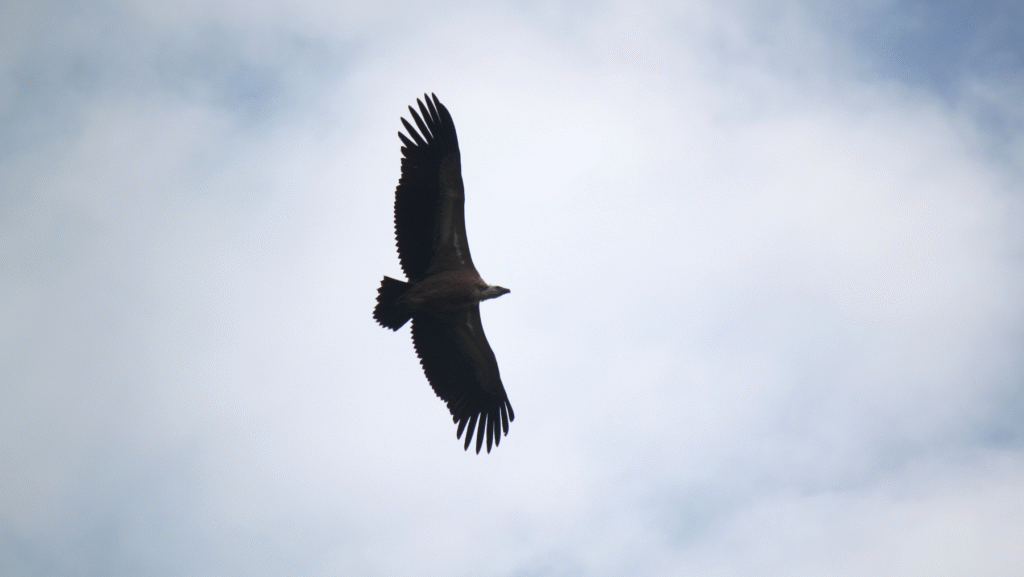
Most of the gorge is dense with black pine, ash and beech forests, and rare wildlife. Trešnjica is one of only two places in Serbia where you can see griffon vultures in the wild (the other is the Uvac Gorge further south, known as ‘Eagle canyon’).
With a wingspan of up to three metres, griffon vultures are genuinely hard to miss when they’re in the air, and watching them ride the thermals above the gorge is one of those experiences that tends to stay with you.
The circular hike begins in the Gornje Tresnjica village. The first bit of the trail is known as the ‘old school route’ because it used to be the route children from the village would take to get to the Gornje Tresnjica school at the bottom of the gorge (which is the hike start/end point). The school is closed now but hikers still use the trail.
After that, the trail plunges into forest, before opening into viewpoints across the gorge and to the river below.
Djerdap Gorge and Golubac fortress
Mali Štrbac trail
Distance: 7km
Difficulty: Moderate. A relaxed, enjoyable walk.
For something completely different, the Djerdap Gorge on Serbia’s northeastern border with Romania is one of the longest river gorges in Europe. We visit on our 7 Day Multi-Activity Holiday in Serbia.
The hiking here follows forested ridges above the Danube, with the river stretching out wide below. On quiet stretches, you can follow the river for hours without seeing another soul. Golubac Fortress, a medieval castle that juts dramatically into the Danube, makes for a compelling stop before or after a day on the trails.
The Mali Štrbac trail begins from the Djerdap state road 35, at a place called Golo Brdo. It passes through forests and ends at the viewpoint Mali Štrbac at 626m. From Mali Štrbac you can continue to Ploče and visit three other viewpoints into the Danube river gorge and then dtake the same route back to Golo Brdo.
Shorter hikes:
Fruška Gora— The ‘Tuscany’ of Serbia
Beyond Belgrade’s legendary nightlife and café culture, the countryside opens out into something greener and wilder. Follow the route of one of the oldest marathons in Europe, the Fruskogorski Marathon which has been going for 40 years. It’s an area of vineyards, forests, rolling hills and quaint villages– Serbia’s so called ‘Tuscany.’
If you want to finish your hike gourmet-style, note that Fruška Gora is known for its vineyards and ‘salas’ farmhouses where locals go in summer for a leisurely countryside lunch.
Suva Planina— Trem trail near Niš
Distance: 14.5 km, 6 hours’ walking
Difficulty: Tricky, involves some rock scrambling.
On your way to Stara Planina, and not far from Niš in southeast Serbia, Suva Planina is a long, flat-topped mountain that doesn’t get nearly the attention it deserves. The Trem trail runs along the ridgeback of the mountain, starting from the Etno dom kafana in Gornja Studena, winding up through the forest, and opening onto a path with views in every direction. It’s a great option if you’re travelling through southern Serbia and want a proper hike without committing to a full mountain expedition.
When to Go
Most mountain routes are best from late May to October. Higher trails like Midžor and Tri Čuke can hold snow well into early summer, so check conditions locally before setting out. The Gradac gorge, Trešnjica and lower-level routes around Tara work across a longer season and are often excellent in spring and early autumn.
Standard mountain rules apply throughout: good boots, layers, and more water than you think you need. Trail marking in Serbia is improving, but it’s still a long way behind Western Europe — going with a local guide makes a real difference and is always our recommendation.
Meet Aleks, our Serbia adventure guide, who says: “I find immense joy in watching people’s preconceptions change once they experience my country, its people and traditional Serbian hospitality first hand. I still haven’t met a person who hasn’t transformed their understanding of Serbia after visiting.”
Browse all our Serbia holidays.
Feeling inspired? Check out our full collection of hiking holidays and subscribe to our newsletter below for free monthly travel tips, offers and updates.
Comments