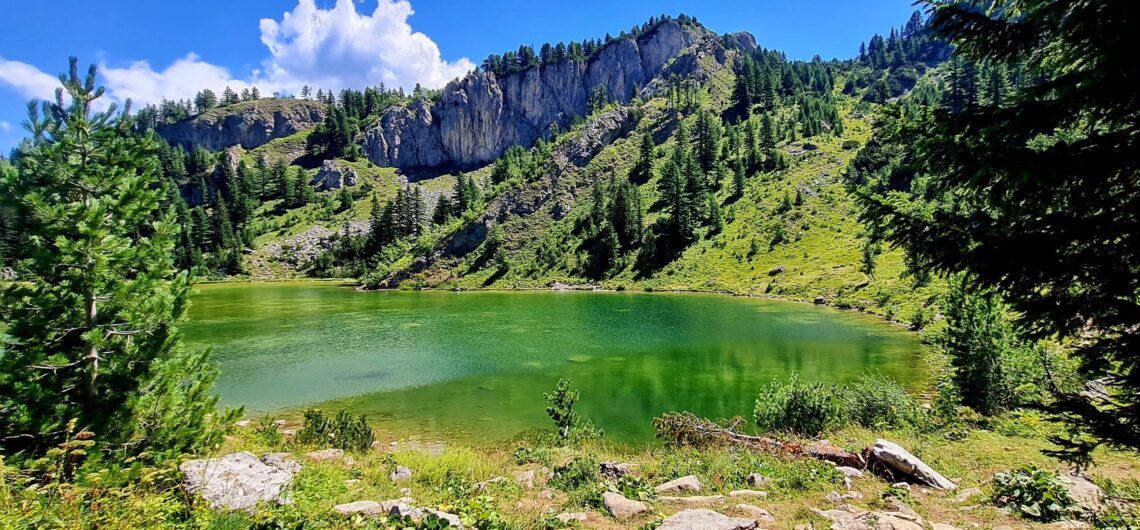
Hiking in Kosovo: the ethereal beauty of Rugova Canyon Kosovo is the most underrated but exciting new destination for adventurers. Balkans travel writer Camilla Bell-Davies shares her firsthand account of hiking and wild swimming in the Rugova Canyon. Last year in June, in search of wild swimming, I hiked the Liqenati lakes trail in Kosovo's Rugova Canyon with Fatos, who leads our Kosovo multi-activity holiday. We met in Peja (or Peć), a town set like a full stop at the end of the dramatic Rugova gorge. Behind it are Kosovo's rolling plains; ahead, the valley walls tighten and the limestone cliffs rise sharply, funnelling the road deep into the mountains. From Peja to the Liqenati lakes After spending a night in Peja, I met Fatos early in the morning and we drove a short way to the start of the Liqenati lakes hiking trail. The first part of the climb was the steepest and most challenging, and already the sun was beating down, carrying the scent of hot soil and pine up from the ground. When the terrain evened out and we were able to speak without huffing and puffing, Fatos told me some of the history of the area. 30 years ago, it would have been impossible to cross these mountains from Kosovo to Albania. When communist dictator Enver Hoxha sealed Albania off from the rest of the world, families living in these borderlands were split overnight, stranded on opposite sides of the mountains. For nearly 50 years, they didn’t see one another. The closest people could come was to stare across the valley through binoculars, sending signals just to show: “I am alive.” That was all. Today, you can cross freely on foot (provided you have the right visa, a guide or hiking permit). It's a reminder that despite
Hiking in Kosovo: the ethereal beauty of Rugova Canyon Kosovo is the most underrated but exciting new destination for adventurers. Balkans travel writer Camilla Bell-Davies shares her firsthand account of hiking and wild swimming in the Rugova Canyon. Last year in June, in search of wild swimming, I hiked the Liqenati lakes trail in Kosovo’s
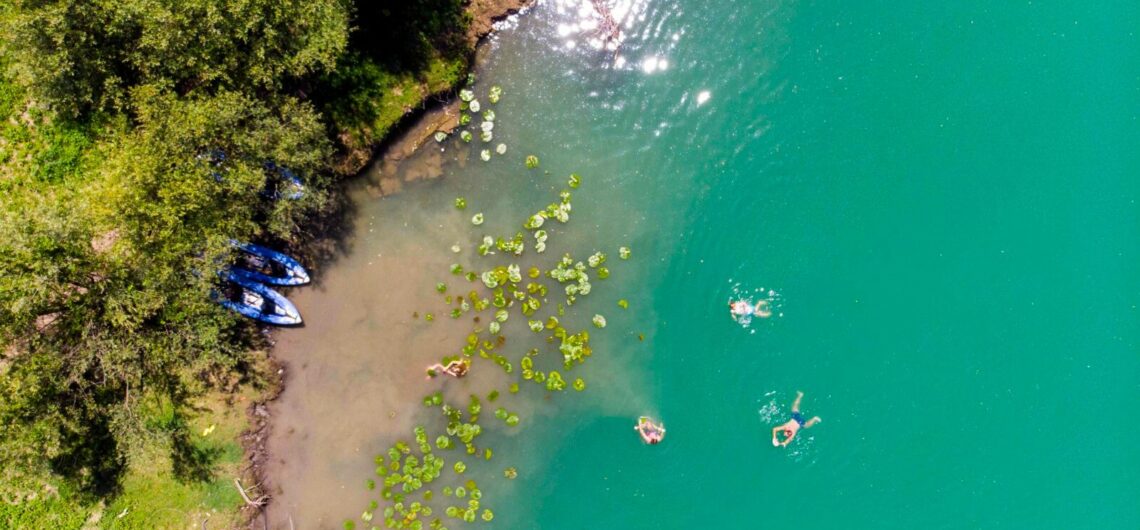
Albania isn't short of lakes, thanks in part to its karst limestone topography. There's no less than 1,040 lakes in Albania (240 natural and 800 man-made), putting it in the running with Italy which has 1,500. So how on earth do you decide which ones are worth visiting? From the Thailand-esque Komani to wildlife-rich Shkodra, here are our top picks of Albanian lakes (many of which you can visit with us on our Albania adventure holidays). Shkodra Nestled in the Dinaric Alps on the border of Montenegro, Shkodra (Skader in Montenegro) is southern Europe’s largest lake at 580 km² in winter. This karst lake is millions of years in the making and is now an important wetlands for species such as the Dalmatian Pelican. On the Albanian side, the lake is named after the charming city of Shkodër. During our North Albania and Albania Multi-Activity holidays, you’ll have a chance to get up close and personal with this beautiful lily-pad strewn lake as we SUP into the reeds and glamp on its shores. We will also visit the village of Zogaj to witness traditional rug weaving at a local co-op. Komani While we’ll always champion natural forms here at Undiscovered Balkans, we can’t deny Komani (aka Koman) reservoir’s beauty. Located in the north around a two-hour drive from Valbona, it’s the result of damming the Drini river in the 1980’s to generate hydro-electric power (a hot topic here in the Balkans). This 13 km² reservoir is incredibly scenic and to us, it resembles Vietnam’s Ha Long Bay or Thailand’s Krabi with its cyan water and dramatic karst cliffs. You’ll be treated to a tranquil ferry ride on after hiking the Theth to Valbona pass during our North Albania holiday. Related: Hiking the Theth to Valbona pass: Meet our homestay host
Albania isn’t short of lakes, thanks in part to its karst limestone topography. There’s no less than 1,040 lakes in Albania (240 natural and 800 man-made), putting it in the running with Italy which has 1,500. So how on earth do you decide which ones are worth visiting? From the Thailand-esque Komani to wildlife-rich Shkodra,
Cold water swimming may be the latest wellness trend but here at Undiscovered Balkans, we were doing it long before it became mainstream. When you live near some of Europe’s cleanest rivers and lakes, it’s impossible to resist. While our friends in the Nordic countries are credited with promoting the health benefits of cold water swimming (aka wild swimming), people in the Balkans have long been doing it for a different reason - religion. On epiphany (19th January), it’s tradition in Montenegro and Serbia to throw a cross in the water and race to catch it. As you can imagine, it’s pretty cold (5°C in Lake Skadar). Watch the 2024 epiphany swim in Podgorica, Montenegro. Temperatures are a little milder in the summer, but swim spots can range from a refreshing dip to a hair raising dunk guaranteed to deliver that adrenaline rush. Over the years, we’ve found some beautiful places for a swim in our Balkan destinations and so we're sharing some of our favourites below. From turquoise waterfalls to lilypad strewn lakes, read on for magical wild swims. The 6 best cold water swims in the Balkans The lakes and rivers listed below are some of the cleanest, wildest and downright most beautiful bodies of water in Europe (not that we’re biassed or anything) and we’ll get you in there at any opportunity during our trips. So, if you've never tried cold water immersion, now's your chance. We’ve listed them from coldest to warmest, depending on how brave you’re feeling. Neretva River, Bosnia & Herzegovina Winter maximum temperature: 1℃ Summer maximum temperature: 7℃ As the world’s coldest river, the Neretva River isn’t for the faint hearted. Fed by three alpine glaciers, the Neretva starts in Lebršnik Mountain in the Dinaric Alps and flows partly through Croatia into
Cold water swimming may be the latest wellness trend but here at Undiscovered Balkans, we were doing it long before it became mainstream. When you live near some of Europe’s cleanest rivers and lakes, it’s impossible to resist. While our friends in the Nordic countries are credited with promoting the health benefits of cold water
This website uses cookies to improve your experience. You may opt-out if you wish. Cookie settingsACCEPT
Privacy & Cookies Policy
Privacy Overview
We use cookies to improve your experience while navigating our website. Of these cookies, those that are categorized as necessary are stored in your browser as they are essential for the basic functionality of the website. We also use third-party cookies that help us analyze and understand how you use this website. These cookies will be stored in your browser only with your consent. You also have the option to opt-out of these cookies. However, opting out of some of these cookies may have an effect on your browsing experience.
Necessary cookies are absolutely essential for this website to function properly. This category only includes cookies that ensure basic functionality and security features of the website. These cookies do not store any personal information.
Any cookies that may not be particularly necessary for this website to function and are used specifically to collect user personal data via analytics, ads, other embedded contents are termed as non-necessary cookies. It is mandatory to procure user consent prior to using these cookies on this website.