Hiking in Kosovo: the ethereal beauty of Rugova Canyon
Kosovo is the most underrated but exciting new destination for adventurers. Balkans travel writer Camilla Bell-Davies shares her firsthand account of hiking and wild swimming in the Rugova Canyon.
Last year in June, in search of wild swimming, I hiked the Liqenati lakes trail in Kosovo’s Rugova Canyon with Fatos, who leads our Kosovo multi-activity holiday. We met in Peja (or Peć), a town set like a full stop at the end of the dramatic Rugova gorge. Behind it are Kosovo’s rolling plains; ahead, the valley walls tighten and the limestone cliffs rise sharply, funnelling the road deep into the mountains.
From Peja to the Liqenati lakes
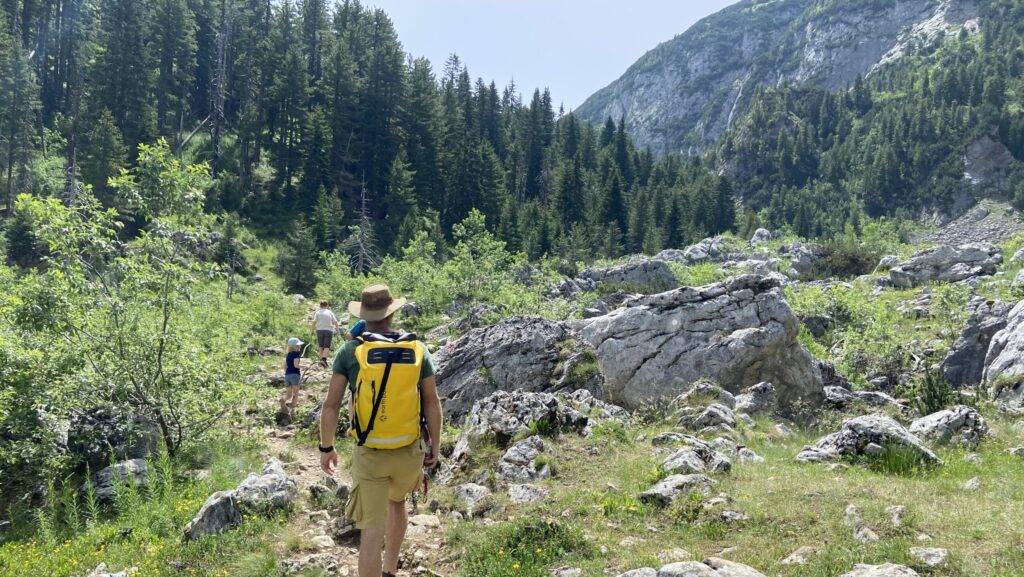
After spending a night in Peja, I met Fatos early in the morning and we drove a short way to the start of the Liqenati lakes hiking trail. The first part of the climb was the steepest and most challenging, and already the sun was beating down, carrying the scent of hot soil and pine up from the ground.
When the terrain evened out and we were able to speak without huffing and puffing, Fatos told me some of the history of the area. 30 years ago, it would have been impossible to cross these mountains from Kosovo to Albania. When communist dictator Enver Hoxha sealed Albania off from the rest of the world, families living in these borderlands were split overnight, stranded on opposite sides of the mountains. For nearly 50 years, they didn’t see one another. The closest people could come was to stare across the valley through binoculars, sending signals just to show: “I am alive.” That was all. Today, you can cross freely on foot (provided you have the right visa, a guide or hiking permit).
It’s a reminder that despite the ethereal beauty of the Balkan region, the past is deeply fraught. But nature heals – that’s how mountain climbers like Fatos see it. “What are borders to us mountain goats?” he said, as though you could roam across the vast distances forever.
Where hiking in Kosovo meets the Peaks of the Balkans
As we hiked, I gazed at the spangling mass of rock above, cloud-capped and drifting in the blue. On the Kosovo side, the mountains were softer, their slopes like worn green velvet. Albania and Montenegro’s peaks loomed beyond – crooked, dark, cutting clean shapes against the sky. Trails wandered off beyond the horizon, into the Peaks of the Balkans hiking trail, one which we tackle on our North Albania adventure.
Being June, the mountains were studded with flowers. Pink gentians, cobalt-blue nivalis, forget-me-nots the colour of the sky and nodding yellow lilies. Wild blueberry bushes hemmed the path and rare orchids hid on rocky slopes. In late July, thousands of white edelweiss would carpet the meadows in a kind of summer snow. Fatos, my guide, stopped to explain each wild flower and I became temporarily lost in their exquisite details before we had to press on.
Read more:
- The 8 best hikes in the Balkans
- 6 things you probably didn’t know about Kosovo
- The best wild swimming spots in the Balkans
Wild swimming in Kosovo’s Rugova mountains
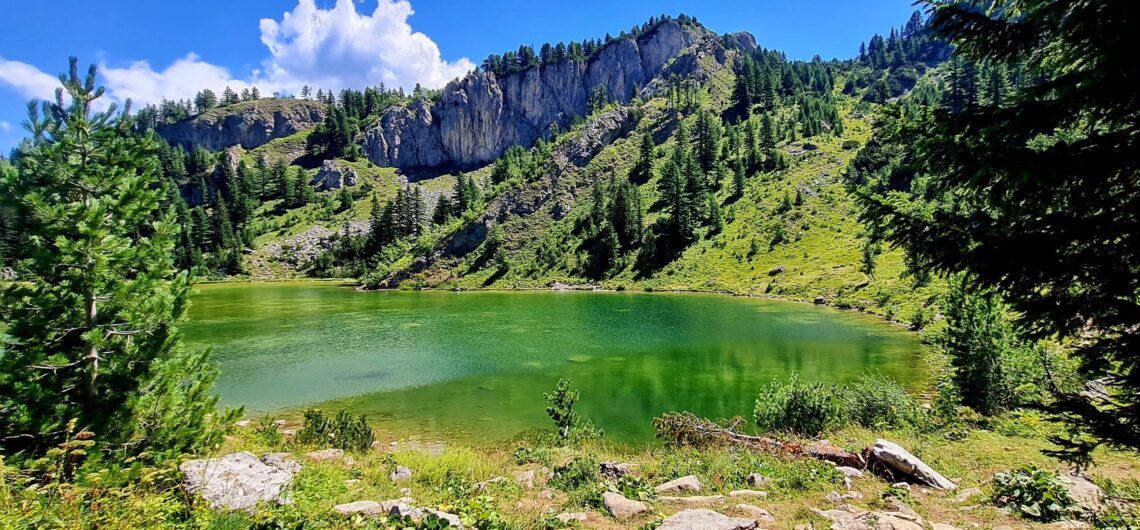
By mid-morning, we reached the first wild swimming lake, ringed by pines and mountains. It was so blue and perfect that I dropped my pack, peeled off some layers and jumped straight in. I swam out to a sunlit patch and floated on my back, gazing up at treetops rising into the sky.
After drying off on a rock, I laced my boots and found Fatos who had been looking for more flowers. We continued upwards into woodland, climbing steadily along a ridge with trees to one side and a valley to the other. Wooden shepherds’ huts sat snug against the hillside, though we didn’t spot any goats.
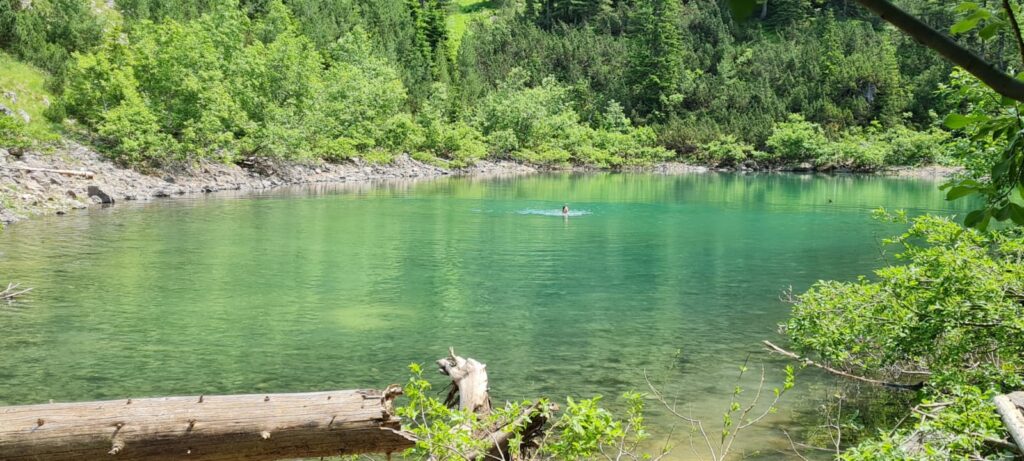
The final climb through the woods was straightforward but tough. When we reached the second lake my legs were aching so I immediately plunged them into the cold lake. This one was smaller, warmed by the sun on the surface but icy underneath. After my swim, I revived with tea and a picnic by the still waters. I could’ve happily spent a week doing nothing but this—walking, wild swimming, eating, repeating.
The descent back through the woods was challenging. Poles would have helped, I thought, as I shimmied down rocks. At one point, a flash of colour stopped us short. A red snake was coiled beside the path. We stomped to announce ourselves and it slid away, unhurried. Good thing I’d worn those high-ankle boots.
Why hiking in Kosovo feels raw and wild
As we neared the end, I saw our first lake gleaming in the seam of the valley. It was filled with the last rays of day, an infinity pool spilling into endless mountains. A few local people from Peja had climbed up for a sunset session, wearing summer dresses and plimsolls and making me feel silly in my sturdy hiking gear.
See how Kosovo, Montenegro and Albania come together on our Albania adventure holidays
I didn’t want the hike to end. These trails pass through one of Europe’s last truly wild regions, where some villages are still reached only on foot and electricity remains a luxury. Just two decades ago, this area was troubled by war, bandits and lines of war refugees. But these days Kosovo is already well into its next chapter. Trails once used for smuggling migrants over mountains are now well-marked and family guesthouses are wide open to visitors.
That night, I stayed at one such guesthouse tucked into a fold of the valley. I arrived as the family were bringing in their cows and a few other hikers were settling in for supper. We exchanged stories and tired smiles before sitting down to thick wedges of homemade flia, a savoury crepe stacked layer upon layer, served with roast pepper ajvar and slabs of salty sheep’s cheese, pressed earlier that day in buckets by the stove. After that, the bliss of sleep came quickly. Tomorrow I would embark for Prizren. The Sharr mountains awaited…
Ready for more adventures by foot in the Balkans? Check out our full collection of hiking holidays and active breaks.
Comments